8 Signs Your Commercial Fire Alarm Panel Needs to Be Replaced
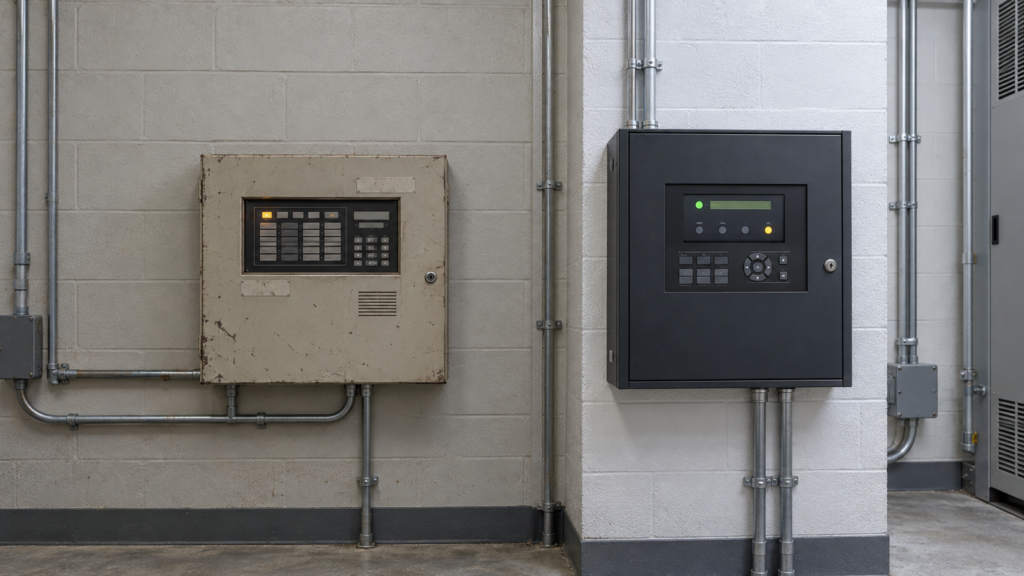
A commercial fire alarm panel typically needs replacement when the manufacturer has discontinued it and parts are no longer available, when it produces repeated trouble or nuisance alarm conditions, when it has no capacity for expansion, or when it still communicates over a copper phone line. Most commercial fire alarm systems reach practical end of life between 15 and 20 years.
Fire alarm panels rarely fail all at once. They decline. A trouble light that gets acknowledged every morning. A detector that nuisance-alarms twice a year and gets bypassed. A technician who mentions that a replacement board took six weeks to find.
By the time the panel actually stops working, it has usually been telling you for two or three years.
Here is what those signals look like, and how to decide whether you are looking at a repair, a panel swap, or a full system replacement.
1. The manufacturer has discontinued the panel
This is the clearest signal, and the one owners tend to hear last because it usually comes up in passing during a service call.
When a manufacturer discontinues a fire alarm control unit, the supply chain does not stop immediately. Distributors sell down inventory, then refurbished boards circulate on the secondary market, then that dries up. Somewhere in that sequence, your service provider is sourcing critical parts from resellers with no warranty and no guarantee of availability.
Ask your provider one direct question: is my panel still in production, and can you get a replacement main board within 48 hours? If the answer is anything other than a clean yes, you are running a system that cannot be reliably restored after a failure.
2. You are seeing repeated trouble signals
An occasional trouble is normal. A ground fault after a storm, a low battery at end of battery life, a device that needs cleaning.
A pattern is not normal. Recurring ground faults, intermittent communication failures on a loop, troubles that clear on their own and come back, or a panel that needs to be reset regularly all indicate that either the panel’s supervision circuitry is degrading or the field wiring has developed problems the panel can no longer reliably characterize.
The cost trap here is that each individual service call is inexpensive. Eighteen months of them is not, and at the end you still have the old panel.
3. Nuisance alarms are happening and devices are getting bypassed
Nuisance alarms are a life safety problem long before they become a code problem, because of what people do in response. Devices get disabled. Zones get bypassed “temporarily.” Staff stop evacuating on the signal.
Older conventional detectors drift out of their sensitivity range and cannot be compensated. Modern addressable panels with drift compensation and pre-alarm thresholds report a detector that is getting dirty before it starts false-alarming. That single capability difference is often the whole business case for an upgrade in a manufacturing, kitchen-adjacent, or dusty warehouse environment.
4. The panel has no capacity left for expansion
You are adding a suite, finishing a mezzanine, or building out a new tenant space, and there are no points left on the loop and no room in the cabinet for another expansion module.
Owners often solve this by adding a second standalone panel. That works technically and creates a maintenance and documentation problem that lasts as long as the building does: two panels, two annunciators, two sets of record drawings, two inspection scopes, and a sequence of operations nobody fully understands five years later.
If expansion is anywhere in your three-year plan, price the panel replacement against the second-panel workaround before you commit.
5. The system is conventional and the building has outgrown it
LA conventional panel reports by zone. When a detector activates, the panel tells you a device somewhere in Zone 4 is in alarm. In a 15,000 square foot building, that is workable. In a 200,000 square foot distribution center, responding firefighters are searching a zone instead of walking to a device.
An addressable panel reports the specific device, with a custom label. “Smoke Detector, 3rd Floor East Corridor, near Suite 312.” The difference in emergency response time is the entire point.
Conventional systems are not non-compliant. They are just badly matched to large or complex buildings, and the mismatch shows up in every alarm response and every inspection.
6. The panel still communicates over a copper phone line
This is the most time-sensitive item on this list.
Traditional copper landline service, commonly called POTS, is being retired by carriers across the country. As copper is retired, many businesses are transitioned onto managed voice replacements or VoIP. Fire alarm communicators designed for copper phone lines are not reliably compatible with VoIP or managed voice replacements, and a communicator that cannot reach the supervising station means an unmonitored fire alarm system.
Warning signs your communicator is at risk:
- Your phone provider has notified you of a copper retirement or a service migration
- Your building’s phone service has already been converted to VoIP
- Your panel uses two dedicated analog phone lines for alarm transmission
- You are seeing intermittent communication failure troubles at the panel
The fix is not always a new panel. Many panels can accept a cellular or dual-path IP communicator, which is a far smaller project. But some older panels cannot, and that is often the moment a panel replacement makes financial sense.
7. You cannot produce the system documentation
No Record of Completion. No current record drawings. No sequence of operations matrix. Inspection reports that start three years ago because that is when the current vendor started.
This is not a panel problem, but it frequently becomes one. Modifying or expanding an undocumented system means reverse-engineering it, and past a certain point the engineering cost of documenting the old system approaches the cost of replacing it with a system that comes with complete documentation.
If your building has changed ownership, changed management companies, or changed fire alarm vendors in the last decade, check the file before you need it.
8. The AHJ or your insurance carrier has flagged it
When a fire marshal writes up the age or condition of the system, or your carrier’s loss control inspector notes it in a survey, the decision has effectively been made for you. The only remaining variable is whether you plan the replacement on your capital schedule or execute it on their deadline.
How long does a commercial fire alarm system last?
Individual components have different practical lifespans:
| Component | Typical practical life |
| Fire alarm control unit | 15 to 20 years |
| Addressable smoke detectors | 10 to 15 years, subject to sensitivity testing |
| Conventional smoke detectors | 10 years, commonly recommended for replacement |
| Notification appliances | 15 to 20 years |
| Sealed lead-acid batteries | 3 to 5 years |
| Communicators | Driven by carrier technology changes, not wear |
NFPA 72 does not set a mandatory replacement age for a fire alarm control unit. What forces the decision in practice is parts availability, manufacturer support, and the ability to pass sensitivity testing. A 22-year-old panel that is still supported and still testing clean can stay. A 12-year-old panel that was discontinued three years ago is a bigger risk.
Can you replace just the fire alarm panel and keep the existing devices?
Sometimes, and it is worth investigating before you budget a full system replacement.
A panel-only replacement may work when:
- The existing field wiring is intact, correctly installed, and passes testing
- The existing devices are compatible with the new panel platform, or the new panel supports the legacy device protocol
- Device coverage still meets current code for the building’s current use
- The building has not been reconfigured since the original install
A full system replacement is usually required when:
- The devices are proprietary to the discontinued panel and no migration path exists
- The wiring is damaged, undersized, improperly installed, or of unknown routing
- The building’s occupancy, layout, or ceiling conditions have changed enough that device coverage no longer complies
- Notification appliance coverage does not meet current audibility and visibility requirements
Several manufacturers build migration paths specifically so existing addressable devices can be carried onto a new panel. This is a meaningful cost difference, and it is one of the first things we look at during a system assessment.
What drives the cost of a fire alarm panel replacement?
Rather than a per-square-foot number that will be wrong for your building, here is what actually moves the price:
- Device count and loop capacity. The single largest driver.
- Panel-only versus full system. Reusing compliant devices and wiring can change the project cost substantially.
- Addressable versus conventional. Addressable costs more up front and reduces inspection labor and false alarm response cost over the system’s life.
- Ceiling and building conditions. Hard-lid ceilings, high bay, exposed structure, and occupied spaces requiring after-hours work all add labor.
- Ancillary interfaces. Elevator recall, HVAC shutdown, door holders, and access control egress release each add engineering and commissioning time.
- Occupied-building phasing. Replacing a system in an operating hospital, school, or 24-hour facility requires phased cutover and interim fire watch planning.
- Permit, plan review, and acceptance testing in your jurisdiction.
- Communicator and monitoring path selection.
What platforms does Guardian Alarm install?
Guardian Alarm is the only Fahrenhyt certified dealer in Michigan. Our technicians are also trained and certified on Fire-Lite, Silent Knight, Honeywell Fire, DMP, and Potter platforms.
Why this matters when you are choosing a partner: a contractor certified on one manufacturer will recommend that manufacturer for every building, because it is the only one they can service. Multi-platform certification means the recommendation can actually be driven by your building. It also means that if you own a portfolio built across different decades by different contractors, one provider can service all of it.
Frequently asked questions about fire alarm panel replacement
How long does a commercial fire alarm panel last?
Most commercial fire alarm control units reach practical end of life between 15 and 20 years. The limiting factor is usually manufacturer support and parts availability rather than the panel physically failing.
Can I replace just the fire alarm panel and keep my existing detectors?
Often yes, if the existing wiring and devices are compatible with the new panel and still provide code-compliant coverage. Several manufacturers offer migration paths for existing addressable devices. A system assessment determines whether this is viable in your building.
What happens if my fire alarm panel is discontinued?
The system remains legal to operate, but replacement parts become progressively harder and more expensive to source. The practical risk is that a board failure leaves the system impaired with no fast repair path, which can trigger a required fire watch.
Will the copper phone landline shutdown affect my fire alarm?
Yes, if your panel transmits alarm signals over a traditional copper phone line. Communicators built for copper phone service are not reliably compatible with VoIP or managed voice replacements. Most panels can be upgraded to cellular or dual-path IP communication, and some older panels cannot.
Is an addressable fire alarm system worth the extra cost?
In larger or more complex buildings, usually yes. Addressable systems identify the specific device in alarm rather than a zone, support drift compensation that reduces nuisance alarms, and cut inspection and troubleshooting labor over the system’s life.
Do I need a permit to replace a fire alarm panel?
In almost all jurisdictions, yes. A panel replacement is a system modification requiring plan review, permit, and AHJ-witnessed acceptance testing.
