Energy Efficiency Meets Security
the ultimate summer home automation checklist
The Summer Surge: Why Efficiency and Security Matter Now
Summer is the season for road trips, neighborhood barbecues, and much-needed family vacations. However, as the temperatures outside climb, so do two major concerns for residential homeowners: skyrocketing utility bills and a seasonal spike in property crime. According to historical data from the Bureau of Justice Statistics, home break-ins frequently peak during the warm summer months when families are traveling or spending long hours away from home. Simultaneously, your HVAC system is working overtime to battle the intense heat and humidity.
Trying to manually manage your home’s climate while constantly worrying about its security can quickly drain the joy out of your summer. But what if you could tackle both of these challenges with a single, intelligent ecosystem?
Quick Takeaways
- Dual Benefits: Integrating your smart home devices with your security system tackles two major summer stressors at once: high utility bills and the seasonal spike in property crime.
- The Power of “Away” Mode: Linking your smart thermostat to your alarm panel ensures your AC automatically dials back the moment you secure your home, preventing wasted energy.
- Illusion of Occupancy: Randomized smart lighting schedules deter burglars by making your empty home look consistently lived-in while you are on summer vacation.
- Phantom Power Prevention: Using smart plugs synced to your security system can cut off power-draining electronics when you leave, saving money and reducing electrical fire risks.
Welcome to the ultimate summer home automation checklist. By fully integrating your smart home devices with your Guardian Alarm security system, you can actively reduce your summer energy usage while creating a powerful, proactive defense against intruders.
Checklist Item 1: Optimize Your Smart Thermostat for “Away” Mode
Heating and cooling account for the largest chunk of your summer energy usage. While a programmable thermostat is helpful, a smart thermostat connected to your security system is a game-changer.
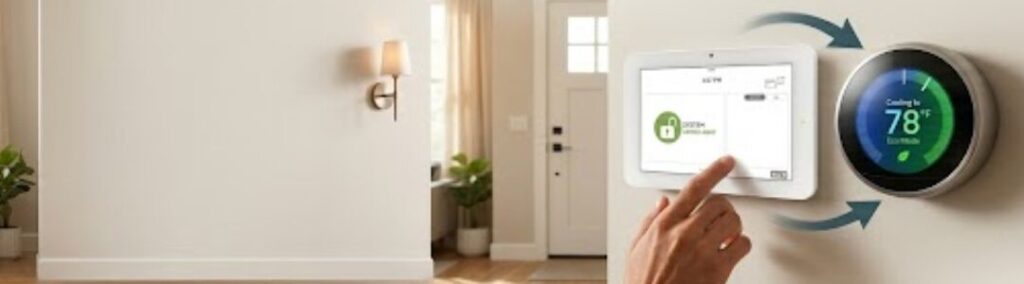
- The Action: Ensure your smart thermostat is paired directly with your Guardian Alarm control panel and smartphone app.
- The Automation: Create a specific rule that tells the system: “When the alarm is armed to ‘Away’, adjust the target temperature up by 5 to 8 degrees.”
- The Benefit: The EPA’s ENERGY STAR program estimates that proper smart thermostat savings can reduce cooling costs by up to 10% annually. Automating this process ensures you never accidentally leave the air conditioning running at full blast in an empty house. The exact second your home is secured, it begins saving you money.
Checklist Item 2: Implement Geo-Fencing for Hands-Free Comfort
You shouldn’t have to choose between saving energy all day and coming home to a sweltering house. Geo-fencing solves this problem beautifully.
- The Action: Utilize the location services within your Guardian Alarm app to draw an invisible perimeter (a “geo-fence”) a few miles around your neighborhood.
- The Automation: When your smartphone crosses this boundary on your evening commute, the system automatically lowers the thermostat to your preferred cooling temperature.
- The Security Bonus: Geo-fencing isn’t just for comfort. You can also set a perimeter alert to notify you if you drive away without arming your security system. With one tap on your screen, you can lock the doors and arm the house remotely, ensuring your property is never left vulnerable.
Checklist Item 3: Schedule Smart Lighting to Mimic Occupancy
Burglars are opportunists. They look for easy targets, and a house that sits completely dark night after night during the summer is a clear indicator that the family is on vacation.
- The Action: Ditch the outdated, predictable mechanical light timers. Connect smart LED bulbs or smart light switches to your central security hub.
- The Automation: Create randomized smart lighting schedules. Instead of a light turning on at exactly 8:00 PM every night, program your living room lights to turn on between 7:45 PM and 8:15 PM.
- The Benefit: This dynamic scheduling creates a highly convincing illusion of occupancy, making it incredibly difficult for anyone casing the neighborhood to tell if you are home or away. Furthermore, because modern LEDs use a fraction of the electricity of older incandescent bulbs, running them for a few extra hours to deter summer break-ins won’t negatively impact your energy bill.
Checklist Item 4: Manage Phantom Power with Smart Plugs
Here is a unique insight that many homeowners overlook: your appliances and electronics continue drawing power even when they are turned off. This is known as “phantom power” or “vampire energy,” and it can add up to 10% to your monthly electric bill.
- The Action: Plug energy-draining electronics—like televisions, gaming consoles, or standing fans—into smart plugs that are integrated with your alarm system.
- The Automation: Program these specific smart plugs to completely cut power to the outlets when the security system is armed.
- The Security Bonus: Beyond lowering your electric bill, completely cutting power to non-essential appliances while you are on a week-long vacation eliminates a common source of unexpected electrical fires. This adds a vital layer of environmental safety to your overall security protocol.
Checklist Item 5: Automate Smart Blinds for Cooling and Privacy
Your home’s windows let in beautiful natural light, but they also let in intense heat and the prying eyes of strangers.
- The Action: Connect motorized smart blinds or window shades to your security ecosystem.
- The Automation: Schedule your blinds to automatically close on south- and west-facing windows during the hottest parts of the day (typically between 12:00 PM and 4:00 PM).
- The Benefit: Blocking the harsh afternoon sun drastically reduces the greenhouse effect in your home, lowering the workload on your air conditioner and extending the life of your HVAC unit. From a security standpoint, closing the blinds during the day prevents “window shoppers”—burglars who peek into homes to scout for high-value items before attempting a break-in.
Summer should be a time of relaxation and creating memories with your family, not a season spent stressing over soaring electricity bills or the safety of your empty house. By viewing your home’s systems holistically, you can see how deeply interconnected comfort, efficiency, and security truly are.
Automating your home for the summer transforms it from a reactive environment into a proactive one. When your smart thermostat, lighting, and access controls all communicate directly with your alarm panel, the house practically manages itself. You eliminate the human error of forgetting to turn off the AC or leaving the porch light on all day. Instead, you gain a seamless, invisible layer of protection that actively works to reduce your carbon footprint, lower your monthly expenses, and completely deter opportunistic criminals.
Don’t wait until you are already halfway to your vacation destination to wonder if your home is secure and efficient. Let technology do the heavy lifting for you. Contact Guardian Alarm today to learn how easily we can upgrade your current system with fully integrated smart thermostats, automated lighting, and advanced security panels. Make this the summer you finally achieve total peace of mind and maximum energy savings.
FAQs
How does a smart thermostat integrate with a home security system?
A smart thermostat integrates with your security system through a central smart hub and a unified mobile app. This connection allows the thermostat to automatically adjust its temperature settings based on the arming status of your security panel, ensuring you never waste energy cooling an empty house.
Can smart lights really help deter summer break-ins?
Yes, smart lighting is one of the most effective burglary deterrents. By scheduling smart lights to turn on and off at randomized times while you are away, you create a convincing illusion that someone is actively moving around the home, which strongly deters criminals looking for empty targets.
What is the best thermostat setting for summer vacations?
To balance energy efficiency with home safety during a summer vacation, the EPA generally recommends setting your smart thermostat to around 85 degrees Fahrenheit. This prevents excessive energy waste while ensuring the home doesn’t get so hot that it damages appliances, drywall, or heat-sensitive electronics.
