The Priority Response Gap
Verified Video Is Now the Standard for Faster Emergency Response
When an alarm goes off at home or business, one question determines everything: will emergency responders show up fast, or will your call sit in a queue behind dozens of unverified signals? The answer depends entirely on how your alarm is reported and that is where most traditional security systems fall short.
Guardian Alarm’s Verified Video monitoring was built to close this gap. By combining real-time visual confirmation with professional monitoring, it transforms your alarm signal from a low-priority data point into a verified, actionable emergency; one that gets police moving faster and responding smarter.
Guardian Alarm has a name for this problem: “The Priority Response Gap”
Verified Video is the solution.
The Priority Response Gap: Why Standard Alarms Are No Longer Enough
Every day, 911 dispatch centers receive thousands of alarm signals. The overwhelming majority are unverified. They indicate a sensor was tripped but offer no proof of whether a real threat exists and police departments, operating under constant resource pressure, must triage these calls by certainty of threat.
A standard alarm sends a blind signal. It tells a dispatcher that something happened, but not what. Without visual confirmation, that call gets assigned a lower priority and slower response times are the result. For homeowners and business owners, that gap between alarm trigger and officer arrival is where real risk lives.
What Is ANSI/TMA AVS-01 Alarm Validation Scoring?
To understand why Verified Video changes everything, it helps to understand the national standard that defines how alarms are classified and reported to emergency services.
The ANSI/TMA AVS-01 Alarm Validation Scoring standard is a nationally recognized framework developed to bring consistency and clarity to how monitoring centers communicate alarm events to 911 dispatch. Certified monitoring stations (including Guardian Alarm) report alarms in one of five defined levels. You can learn more about the certification at UL’s AVS-01 Alarm Validation Scoring Certification page.
The Five AVS-01 Alarm Levels
- Alarm Level 0 – No call for service
- Alarm Level 1 – Call for service with no additional information
- Alarm Level 2 – Call for service with proof or high probability of human presence at the alarm site
- Alarm Level 3 – Call for service with confirmed human presence, and an apparent threat to property
- Alarm Level 4 – Call for service with confirmed human presence, and an apparent threat to life
Most standard alarm systems can only ever reach Level 1. A sensor trips, a signal goes out, and the call for service is made with no supporting context. Guardian Alarm’s Verified Video monitoring enables operators to escalate to Level 3 or 4 by visually confirming what is happening at your property and putting your emergency call at the top of the dispatch queue.
How Guardian Verification Works
Guardian Verification is a monitoring enhancement enabled through Guardian Alarm’s partnership with Alarm.com. It bridges the gap between a passive sensor and a first responder through a seamless, privacy-focused four-step process.

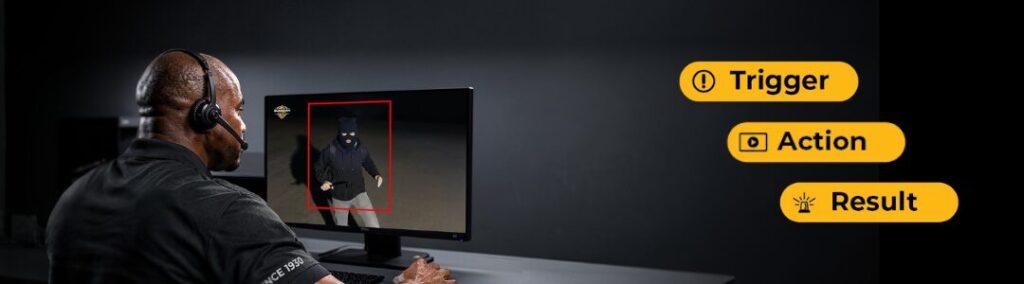
Your alarm is tripped and a signal is sent to Guardian’s professional monitoring team.

Guardian operators receive a secure, temporary link to view live video from your cameras.

The team confirms the alarm in real time & communicate the higher priority dispatch.
Operators follow standard procedures to determine if dispatch is required. If so, they will call 911 while simultaneously accessing the live video view for 15 minutes after the event and can review recorded clips for 24 hours to fully assess the situation. Your privacy is protected throughout this process.
Guardian operators only receive access when an alarm is triggered. Outside of an active alarm event, there is no access to your cameras and at no time does Guardian have the ability to download any customer video footage.
Verified Video for Homeowners:
A Guard on Your Front Porch
Your home is where your family sleeps, where your kids grow up, and where you should feel safe. Guardian Alarm’s Video Verification is designed to protect that space with the same attentiveness you would expect from a dedicated security guard at a fraction of the cost.
The moment standard dispatch procedures begin; a Guardian Alarm operator can simultaneously access the live video link to see exactly what triggered the alarm. If a real threat is confirmed while on the line with 911, police are provided with verified information, giving your call the highest possible priority.
That distinction matters more than most homeowners realize. An unverified alarm puts you at the back of the dispatch line. A Guardian verified alarm tells police: this is real, this is confirmed, and someone needs help now.
Verified Video for Businesses:
Continuity, Not Just Security
For commercial customers, Guardian Verification is not a gadget, it is a business continuity tool. Business owners carry constant, low-level anxiety about what happens at their location after hours.
Guardian Alarm’s promise to commercial clients is direct: go home, sleep soundly. If something happens at the shop, we will see it and we will handle it.
Beyond the security benefit, Verified Video directly addresses one of the most common frustrations for business owners: false alarm fines. Standard motion sensors can be triggered by delivery drivers, HVAC movement, cleaning crews, or shifting light. With visual confirmation, Guardian operators filter out nonthreats during the dispatch process, reducing unnecessary dispatches and the fines that come with them.
The Benefits of Guardian Verification at a Glance
Faster Emergency Response
Verified alarms receive higher priority from police dispatch. When Guardian communicates a confirmed threat at Alarm Level 3 or at Level 4, responders treat the call with the urgency it deserves.
Improved Situational Awareness
First responders arrive knowing what they are walking into — not guessing. Visual confirmation means officers can approach the scene informed, improving both their safety and their effectiveness.
False Alarm Reduction
Visual confirmation provides real time validation during the dispatch process. If an operator identifies a false alarm while on the line with 911, they can immediately update the dispatcher to cancel the response. This protects customers from false alarm fines and helps preserve police resources for real emergencies.
Evidence for Documentation
Video clips captured during an alarm event are preserved and available to assist with insurance claims or legal proceedings following an incident (sourced from the customer’s video system only).
Complete Peace of Mind
Customers know their alarms are actively monitored and validated the moment a dispatch call begins. That certainty that someone is simultaneously coordinating with police and watching the live feed is the foundation of real security.
Upgrade to Verified Video Monitoring Today
Guardian Alarm’s Verified Video monitoring is available now for residential and commercial customers. Whether you are protecting your family at home or safeguarding your business after hours, Guardian Verification raises the standard of what professional monitoring can deliver.
Call today to learn more about your options and upgrade your security response priority today.
FAQs About Verified Video Monitoring
Can Guardian Alarm watch my cameras whenever they want?
No. Guardian operators only receive a secure, temporary link to view video when an alarm is triggered and a signal is sent to the monitoring team. Access to the live view is available for 15 minutes after the event, and recorded clips are reviewable for 24 hours. Outside of active alarm events, Guardian has no access to your cameras and cannot download customer video footage at any time.
Will Verified Video actually make police arrive faster?
Yes. Under the ANSI/TMA AVS-01 framework, verified alarms are communicated to dispatch at higher alarm levels than unverified signals. When Guardian Alarm confirms a real threat, that information is passed directly to dispatchers, resulting in higher-priority response.
Does Verified Video work for both homes and businesses?
Video clips are preserved following an incident and can be used as evidence for insurance claims or legal needs. Immediate response and documentation are handled simultaneously.
What happens to video footage after an alarm event?
Professional installers identify vulnerabilities you might miss, such as a hidden basement window or a weak side door. They ensure all hardware is mounted securely and integrated correctly with the monitoring software, providing a level of “set-it-and-forget-it” reliability that self-installed kits rarely achieve.
How does verified video response reduce false alarm fines?
When standard dispatch procedures are initiated, Guardian operators review the video feed while simultaneously contacting 911. If the video reveals a clear false alarm, operators can communicate this to dispatchers in real time, significantly reducing unnecessary dispatch calls and associated fines.
