Senior Home Security
Protecting Loved Ones with Smart Cameras
Quick Takeaways
- Proactive Protection: Smart cameras deter crime before it happens and allow for safe screening of visitors at the door.
- Check-in Capability: Indoor and outdoor cameras allow adult children to non-intrusively check on the well-being and routines of aging parents.
- Professional Reliability: Unlike DIY apps, Guardian Alarm offers professionally monitored systems that act even if you miss a notification.
- System Health: Guardian monitors the status of the devices themselves, ensuring that connection drops or power issues are detected immediately.
- Privacy First: Strategic camera placement balances safety with the dignity and privacy your loved ones deserve.
Protecting Those Who Once Protected Us
There is a distinct shift that happens in adulthood, a quiet turning of the tables where the roles reverse. For years, our parents were the guardians of our safety, checking locks and leaving porch lights on. Now, as they age and we build lives of our own, the weight of worry shifts to us.
We find ourselves wondering: Did Mom get the mail okay? Is Dad safe alone in that big house?
When it comes to the safety of our aging parents, uncertainty is the heaviest burden to carry. We don’t just want to hope they are safe; we want to know.
In the landscape of modern caregiving, family safety technology has evolved beyond simple burglar alarms. It has become a bridge of connection and a source of deep, abiding reassurance. Implementing a system of smart cameras isn’t about surveillance; it is about extending a circle of care that ensures threats don’t get past the front door, and that peace of mind is preserved within it.
Beyond the Alarm: The Role of Cameras in Senior Independence
For many seniors, the goal is “aging in place”—maintaining independence in the home they love. However, this independence can be fragile. Home security for parents is about preserving that dignity while adding a necessary layer of protection.
Smart cameras serve as the eyes that never blink, offering two distinct forms of protection:
- Deterrence: Preventing bad actors from targeting the home.
- Connection: Allowing adult children to check in without being intrusive.
This balance is vital. It moves the conversation from fear to empowerment. It allows your loved ones to live freely, knowing that a sophisticated digital safety net is woven around them.
Choosing the Right Tools: A Layered Approach to Security
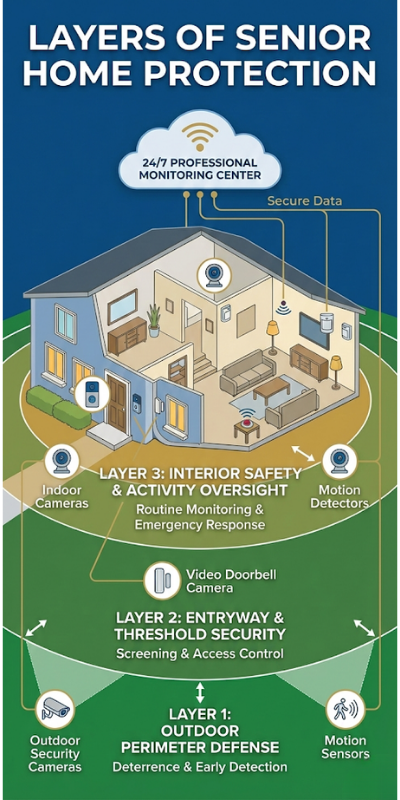
To create a comprehensive safety net, we must look at the home as a series of zones. Each zone requires a different type of technology to ensure total coverage.
The Front Line: Video Doorbell Cameras
The front door is the primary threshold of the home. It is where packages arrive, where friends visit, and unfortunately, where scams often begin. Video doorbell cameras are the first line of defense.
For seniors, the doorbell camera is a powerful tool against solicitation fraud and “doorstep scams.” With two-way audio, you or your parents can screen visitors without ever opening the door. If a stranger approaches, you can verify their identity via your smartphone app, ensuring your parents never have to confront an unknown situation alone.
Perimeter Defense: Outdoor Security Cameras
While the doorbell covers the entrance, outdoor security cameras cover the blind spots—the driveway, the back patio, or the side gate. These devices are crucial for detecting activity before it reaches the physical structure of the home.
High-definition video with night vision ensures that lighting conditions don’t compromise safety. Furthermore, the mere presence of a visible outdoor camera is a profound psychological deterrent to potential intruders. They signal that this home is watched, cared for, and protected.
Compassionate Oversight: Indoor Cameras
Integrating indoor cameras requires a conversation about home security privacy. Unlike outdoor cameras, these are invited into the intimate spaces of daily life. However, for aging parents with medical conditions or mobility issues, they can be life-saving.
Strategically placing a camera in a high-traffic area, like a hallway or kitchen (avoiding bedrooms and bathrooms to maintain dignity), allows for non-invasive check-ins. Did Dad make it to the kitchen for breakfast? Did the caregiver arrive on time? These insights allow you to spot irregularities in routine that might signal a health issue, long before a crisis occurs.
The Guardian Difference: Monitoring
In the DIY era, many homeowners fall into the trap of believing that an app notification is the same as security. It is not. This is the critical difference between self-monitoring and professionally monitored security systems.
If you rely solely on self-monitoring, you become the security guard. If you are in a meeting, on a flight, or asleep when an alert comes through, the safety net fails. Unreliable Wi-Fi or a dead phone battery shouldn’t determine your parent’s safety.
With Guardian Alarm, we provide certainty.
- Action, Not Just Alerts: If a camera detects a confirmed threat or a sensor is tripped, our monitoring center doesn’t just send a text; we act. We can verify the emergency and dispatch help immediately.
- System Health Monitoring: A security system is only as good as its connection. Guardian Alarm devices are monitored for disturbances or loss of connection. If a camera goes offline or a battery runs low, the system status is continuously monitored so issues don’t go unnoticed.
This is the “faith-adjacent” assurance we speak of—the confidence that even when you cannot watch over them, someone competent and caring is.
Creating Assurance, Not Just Alerts
The ultimate goal of installing this technology is not to create a fortress of fear, but a sanctuary of peace. When threats don’t get past the front door, life inside continues uninterrupted.
Guardian Alarm systems are installed, tested, and verified by professionals. We don’t leave you with a box of wires and a manual; we leave you with a fully integrated ecosystem of safety. This means your parents don’t have to fiddle with technology, and you don’t have to worry if the system is actually working.
By integrating smart cameras with professional monitoring, you are giving your parents the freedom to live their lives, and giving yourself the freedom to sleep soundly. It is a profound act of love to say, “I have made sure you are safe.”
Caring for aging parents is a journey filled with love, nostalgia, and admittedly, a fair amount of worry. But we live in an age where technology can shoulder some of that burden. By equipping your parent’s home with video doorbell cameras, outdoor security cameras, and the backing of Guardian Alarm’s professional monitoring, you are replacing “what if” with “all is well.”
This isn’t just about preventing break-ins; it is about preserving the sanctity of the home and the independence of the people who built it. With the right support, you can ensure that your parents are protected physically and digitally, giving everyone in the family the peace of mind they deserve.
Would you like to schedule a free security consultation to discuss the specific needs of your parent’s home?
Frequently Asked Questions About Senior Safety
Can smart cameras work if my parents don’t have a smartphone?
Yes. While smartphones allow for remote viewing, the primary benefit of a Guardian Alarm system is professional monitoring. Our monitoring center watches over the system 24/7/365. Your parents do not need to interact with an app to be protected; the system works automatically to secure the home.
What happens to the security system if the Wi-Fi goes down?
Guardian Alarm systems utilize backup communication technologies. If the internet connection is lost or disturbed, the system status is monitored to detect this loss. Professional installation ensures that backup protocols are in place so that the link to the monitoring center remains reliable during outages.
Is it an invasion of privacy to install cameras in my parents’ house?
It is important to discuss home security privacy openly. We recommend placing cameras in common areas like kitchens, living rooms, and exteriors, avoiding private spaces like bathrooms or bedrooms. The goal is to monitor safety and routine (e.g., ensuring they are up and moving), not to scrutinize every private moment.
How do doorbell cameras prevent scams against the elderly?
Video doorbells allow residents to see and speak to visitors without opening the door. This physical barrier prevents forced entry. Additionally, family members can access the feed remotely to intervene or verify the visitor’s identity, effectively stopping high-pressure solicitation or “distraction” burglaries before they escalate.
