Department Store Security: A Practical Guide for Protecting People, Products, and Operations
Department stores are designed to be open. Customers move between departments and try on merchandise. They make returns, pick up orders, and check out in different parts of the building.
That openness is part of the shopping experience. It also makes department stores harder to secure.
Retailers are dealing with a more complex risk environment than they were just a few years ago. According to the National Retail Federation’s 2025 theft and violence study, retailers reported an 18% increase in the average number of shoplifting incidents in 2024 compared with 2023. The same study found that threats or acts of violence during theft events rose 17% year over year.
That pressure builds on a longer trend. NRF’s 2024 retail theft and violence research found that retailers reported a 93% increase in the average number of shoplifting incidents in 2023 compared with 2019.
For department stores, the answer is not simply “add more cameras.” A strong security program needs to protect employees, customers, merchandise, payment systems, and daily operations. It also needs to do that without making legitimate shoppers feel unwelcome.
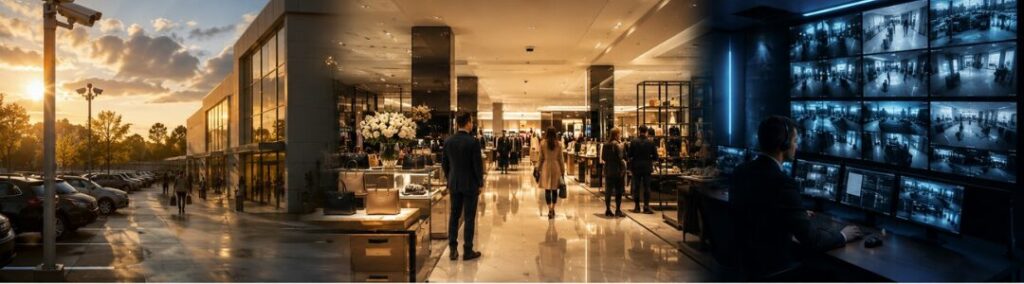
Guardian Alarm helps retailers build that kind of layered program. Its retail security solutions are designed to protect stores with video surveillance, access control, intrusion alarms, remote monitoring, fire protection, and life safety systems. Guardian Alarm describes its retail protection as covering the store “from the parking lot to the register.”
Why Department Store Security Is Different
A department store is not one security environment. It is a group of connected risk zones.
| Store area | Security concern |
|---|---|
| Entrances and exits | Theft deterrence, alarm response, and customer flow |
| Sales floor | Visibility, staff safety, and merchandise protection |
| High-value departments | Shrink reduction and evidence capture |
| Returns and service desks | Refund fraud, disputes, and transaction review |
| Stockrooms and receiving areas | Unauthorized access and internal loss |
| Parking areas | After-hours activity, vandalism, and employee safety |
A good security plan connects those areas. The goal is not only to stop theft. The goal is to reduce shrink, protect people, shorten investigations, limit false alarms, and keep the store operating smoothly.
The Major Threats Department Stores Need to Plan For
Shoplifting and Organized Retail Theft
Shoplifting can be opportunistic. It can also be coordinated.
The FBI defines organized retail theft as large-scale theft of retail merchandise with the intent to resell stolen items for financial gain. The FBI notes that these crimes may involve groups stealing large quantities of merchandise from multiple stores.
Department stores can be attractive targets because they carry merchandise with strong resale value. Beauty products, apparel, accessories, electronics, and luxury items can all be vulnerable.
Employee and Customer Safety Risks
Theft is not the only concern. Retail security also needs to protect the people inside and around the store.
OSHA recommends that employers use workplace violence prevention measures such as video surveillance, extra lighting, alarm systems, and limits on unauthorized access where appropriate. OSHA also recommends drop safes to reduce the amount of cash on hand.
For department stores, that means safety planning should include parking areas, customer service desks, employee entrances, and closing procedures. It also means employees need clear guidance on when to report, when to disengage, and when to call for help.
Internal Theft and Operational Loss
Not every loss starts with a customer. Internal theft, improper discounts, refund abuse, and cash-handling errors can all contribute to shrink.
This is where integrated systems matter. When video, access control, alarms, and transaction data work together, managers can investigate problems faster and with stronger evidence.
After-Hours Intrusion and Vandalism
Department stores often have large footprints. They may also have multiple exterior doors and receiving areas. After closing, those spaces can create risk.
Intrusion alarms, video verification, and remote monitoring can help identify real threats more quickly. They can also help reduce unnecessary alarm dispatches.
Payment and Cybersecurity Risk
Modern department stores rely on connected systems. POS terminals process payments. Cameras store footage. Access control platforms manage credentials. Guest Wi-Fi supports shoppers.
Those systems need to be protected too. A security plan that ignores cybersecurity leaves a major gap.
A Layered Approach to Department Store Security
The strongest department store security programs use layers. Each layer supports the next. If one control misses something, another control can help detect, delay, verify, or document the event.
1. Start With a Store Security Assessment
Before adding equipment, start with a clear view of the store’s actual risk.
A useful assessment answers three questions:
Where are we most exposed? This may include exterior doors, fitting room corridors, receiving areas, high-shrink departments, or the parking lot.
Where are we losing time? Look for slow investigations, frequent false alarms, unclear incident reports, or gaps in video coverage.
Where are we relying too heavily on employees? Staff should not be expected to solve security problems without tools, training, and escalation procedures.
Guardian Alarm offers a free business security review to help businesses identify vulnerabilities and strengthen their defenses.
2. Use Video Surveillance as the Visual Foundation
Video surveillance is one of the most important parts of department store security. It can deter theft, verify alarms, document incidents, and support investigations.
Guardian Alarm’s business camera systems are designed to help businesses stop crime before it happens and improve operational visibility.
The best camera plan is not based on maximum coverage alone. It is based on useful coverage.
A stronger camera plan prioritizes:
- Clear views at entrances and exits
- Usable footage at registers and returns
- Strong coverage in high-value departments
- Visibility near receiving and stockroom doors
- Parking lot coverage where lighting supports it
Privacy matters too. Cameras should be placed to protect customers and employees without recording areas where privacy is expected.
3. Add Remote Video Monitoring for Real-Time Response
Traditional cameras often help after an incident. Remote video monitoring can help while an incident is happening.
Guardian Alarm’s remote video monitoring uses AI-driven video analytics to identify threats and intruders. Trained security analysts can then intervene with audio warnings and alert authorities when needed.
| Best-fit area | Why monitoring helps |
|---|---|
| Parking lots | Extends visibility after closing and during low-staff hours |
| Loading docks | Helps protect receiving areas when vendors are not present |
| Exterior doors | Supports faster verification of after-hours activity |
| Seasonal displays | Helps protect temporary outdoor merchandise or equipment |
Remote monitoring is especially valuable when a store has repeated after-hours incidents or a large exterior footprint.
4. Control Access to Back-of-House Areas
Customers need access to the sales floor. They do not need access to the stockroom, receiving dock, cash office, IT closet, or manager suite.
Access control helps department stores manage who can enter restricted areas. It also creates a record of access activity.
Guardian Alarm’s business access control systems include cloud-based management and integration with systems such as intrusion alarms, video cameras, HR databases, and visitor management tools.
| Old approach | Stronger approach |
|---|---|
| Shared keys | Individual credentials |
| Same access for many employees | Role-based access |
| Manual lock changes | Fast credential removal |
| No entry record | Searchable access logs |
| Standalone doors | Access events tied to video |
Access control is especially important for stockrooms, receiving areas, cash offices, and high-value storage.
5. Protect High-Shrink Departments With Focused Controls
Not every department needs the same level of protection. A risk-based plan puts the strongest controls where loss is most likely or most costly.
Think of high-shrink protection in three tiers.
Tier 1: Visibility Improve sightlines. Add cameras where footage will actually help. Place employees where they can greet customers and observe activity.
Tier 2: Friction where it makes sense Use locked cases, tethering, electronic article surveillance, or controlled access for the highest-risk products. Avoid overusing friction in ways that punish legitimate shoppers.
Tier 3: Investigation support Connect video, POS activity, incident notes, and inventory data. This helps teams identify patterns instead of treating each incident as isolated.
For department stores, the right mix may vary by location. A cosmetics department may need a different approach than a jewelry counter or an apparel floor.
6. Strengthen Returns, Exchanges, and POS Oversight
Returns and checkout areas are customer service spaces. They are also common loss points.
A practical workflow can look like this:
Transaction exception > video review > manager note > case file > trend review
That workflow helps teams move from one-off reactions to pattern recognition.
Common warning signs include repeated refunds without receipts, unusual manager overrides, mismatched merchandise, and high void activity. Video coverage should be clear enough to verify what happened at the counter. POS reporting should make it easy to find the transaction in question.
This does not mean every exception is fraud. It means the store has a fair and consistent way to review risk.
7. Use Intrusion Alarms and Verified Response Workflows
Intrusion alarms remain essential for department stores. The system should reflect how the store actually operates after hours.
A good alarm design separates the building into meaningful zones. Exterior doors may be one zone. Receiving may be another. High-value departments may need a different after-hours rule.
The store also needs a clear response workflow:
| Alarm event | Response question |
|---|---|
| Door contact | Was the door forced, propped, or opened by an authorized user? |
| Motion event | Is there video confirmation? |
| Glass break | Is there evidence of entry or damage? |
| Repeated false alarm | Does the device, schedule, or user process need adjustment? |
Video verification can make alarm response more efficient. It helps teams determine whether an event is a real threat, an employee error, or an equipment issue.
8. Do Not Overlook Fire and Life Safety
Security is broader than theft prevention. Department stores also need systems that protect people from fire, carbon monoxide, and other emergencies.
Guardian Alarm provides commercial fire alarm monitoring and life safety solutions that pair safety alarms with 24/7 monitoring for businesses.
A strong life safety program should include monitored detection, inspection schedules, staff training, and clear evacuation procedures. It should also account for peak shopping periods, when occupancy is higher and movement through the store may be slower.
9. Train Employees for Safety, Not Confrontation
Technology cannot replace training. Employees need to know what to do before an incident escalates.
Three rules should guide the training program.
Observe and report. Employees should know what details matter, such as time, location, behavior, and direction of travel.
De-escalate when possible. Staff should have practical language for tense customer interactions. They should also know when to disengage.
Prioritize people over products. Employees should not be expected to risk their safety to stop theft.
This training should be repeated, not buried in onboarding. It should also be tailored to real store scenarios.
10. Build a Better Evidence and Incident Response Process
After an incident, the quality of the response matters. Poor evidence handling can slow investigations and weaken claims.
A complete incident file should answer:
| Question | What to capture |
|---|---|
| What happened? | Incident summary and category |
| When did it happen? | Time stamps from video, POS, alarm, or access control |
| Where did it happen? | Department, door, register, or exterior area |
| What evidence exists? | Video clips, transaction records, photos, and access logs |
| Who reviewed it? | Manager, loss prevention, HR, or law enforcement contact |
| What happened next? | Resolution, escalation, or follow-up action |
For organized retail theft, consistency is especially important. The FBI notes that ORT can involve groups stealing from multiple stores, which means repeat details may matter across locations.
11. Secure Payment Systems and Retail Technology
Physical security and cybersecurity now overlap.
A camera system can create risk if it is poorly secured. So can an access control dashboard. POS systems need even tighter controls because they handle payment activity.
The National Institute of Standards and Technology’s Cybersecurity Framework 2.0 organizes cybersecurity outcomes around Govern, Identify, Protect, Detect, Respond, and Recover. NIST says the framework helps organizations better understand and improve cybersecurity risk management.
Payment systems also have their own obligations. The PCI Security Standards Council explains that PCI DSS applies to entities that store, process, or transmit cardholder data, as well as entities that could affect the security of the cardholder data environment.
For department stores, practical cybersecurity steps include network separation, multi-factor authentication, regular software updates, and fast removal of former employee access. POS traffic should not share the same trust path as guest Wi-Fi. Security devices should be managed with the same discipline as other business systems.
12. Respect Privacy and Compliance Requirements
Department stores collect sensitive information through cameras, access logs, incident reports, and payment systems. Those tools should be governed by clear policies.
| Policy area | Why it matters |
|---|---|
| Notice | Customers and employees may need to know surveillance is in use |
| Retention | Footage should not be kept longer than necessary |
| Access | Only authorized users should view or export video |
| Audio | Recording laws vary by state |
| Biometrics | Facial recognition or face-template tools can create legal risk |
| Vendors | Third parties may handle footage, logs, or alarm data |
Any use of audio recording, biometric tools, or employee monitoring should be reviewed with legal counsel. Requirements vary by jurisdiction.
Department Store Security Self-Audit
Use these questions to evaluate whether your current security program is covering the basics.
| Area | Ask this question |
|---|---|
| Exterior | Are parking areas, entrances, and employee doors visible and well lit? |
| Sales floor | Do high-risk departments have usable camera coverage? |
| Registers | Can managers match a transaction exception to video quickly? |
| Returns | Are suspicious refund patterns reviewed consistently? |
| Stockrooms | Is access limited by role and schedule? |
| Receiving | Are vendor and delivery areas monitored? |
| Alarms | Are false alarms reviewed and corrected? |
| Training | Do employees know when to report, disengage, or escalate? |
| Evidence | Are incident files complete and easy to retrieve? |
| Cybersecurity | Are POS systems separated from guest and security networks? |
How Guardian Alarm Helps Department Stores Build Stronger Security
Department store security works best when systems are connected. Cameras, alarms, access control, monitoring, and life safety systems should support the same operating plan.
Guardian Alarm’s business security solutions include video surveillance, intrusion alarms, remote video monitoring, access control, fire and life safety, worker safety, mobile security towers, and business analytics. Guardian also emphasizes local support, end-to-end enterprise security, and solutions engineered around a business’s needs and budget.
For department stores, that matters. A retailer may need cameras at entrances, access control at stockrooms, alarm monitoring after close, and remote video monitoring outside the building. Fire and life safety systems also need to be part of the plan.
Guardian Alarm can help department stores assess risk, design a layered program, and implement security solutions that protect people and property across the full store environment.
Final Thoughts
Department store security is no longer only about catching theft after it happens. It is about building a safer and more resilient retail environment.
The right program protects customers, employees, merchandise, payment systems, and operations. It uses visible deterrence without overwhelming the shopping experience. It gives employees support without asking them to take unnecessary risks.
For department stores facing rising theft, safety concerns, and more complex operations, a layered security strategy is the strongest path forward.
Guardian Alarm can help department stores identify vulnerabilities, improve response, and protect what matters most – from the parking lot to the register.
