Community Pool Security: How to Protect Apartment, Condo, and Municipal Pools
A pool is one of the most valued amenities a property can offer — and one of the hardest to protect. It sits outdoors, often unstaffed, frequently after dark, and surrounded by an audience of residents, guests, and passersby who all believe the rules don’t quite apply to them after closing time. For property managers, HOA boards, parks departments, and homeowners alike, the pool deck is where convenience and liability meet.
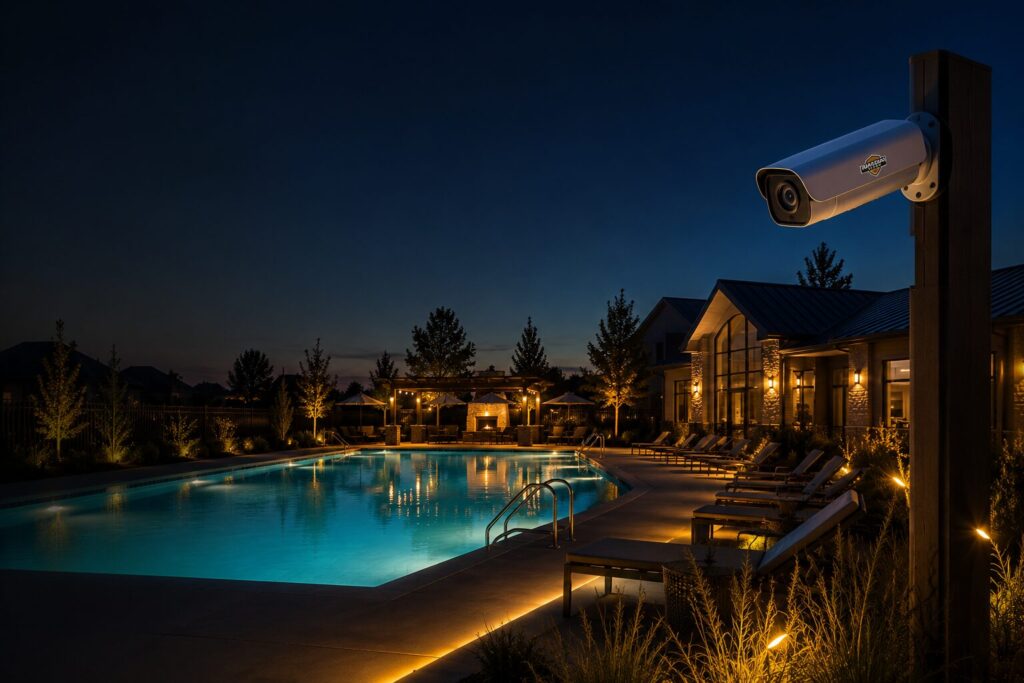
The good news: modern pool security has moved well beyond a padlocked gate and a faded “No Lifeguard on Duty” sign. With AI-powered cameras, remote video monitoring, and smart access control, you can deter after-hours trespassing, document incidents, and respond to problems in real time — without paying a guard to sit poolside all night.
Here’s how to think about pool security across the four most common scenarios.
Why Pool Security Is a Bigger Risk Than Most Owners Realize
Pools concentrate several kinds of risk into one small footprint:
After-hours trespassing. The most common pool security problem is simple: people use the pool when it’s closed. Unsupervised swimming, jumped fences, propped gates, and “guests of guests” all create exposure — and they tend to happen at the exact hours no one is watching.
Liability and drowning risk. An unsecured pool is an attractive nuisance. When access controls fail and an incident occurs, the property owner is often the one answering for it. Strong perimeter security and reliable access logging aren’t just about catching vandals — they’re a core part of limiting liability.
Vandalism, theft, and loitering. Pool furniture, pumps, heaters, and equipment rooms are frequent targets. Pool areas also attract loitering and after-hours gatherings that disturb residents and damage property.
Disputes and “he-said-she-said” incidents. Slip-and-falls, altercations, and rule violations turn into claims. Recorded video is often the single most valuable piece of evidence a property has.
A good pool security strategy addresses all four — and the right mix of tools depends on who owns the pool and who uses it.
Apartment Community Pools
Apartment pools are high-traffic, high-turnover, and notoriously hard to police. Residents come and go, leases change, and access cards or fobs circulate far beyond the people they were issued to.
The biggest challenge here is access. A pool gate that anyone can prop open is no gate at all. Pairing the pool entrance with electronic access control — fobs, mobile credentials, or PIN entry — lets you grant access only to current residents, automatically revoke it when a lease ends, and keep a log of every entry. If a gate is propped or an entry happens at 3 a.m., the system can flag it.
Layer in AI video surveillance covering the gate, deck, and equipment area, and you can verify who’s actually using the amenity, enforce posted hours, and respond to disturbances before they escalate into a 2 a.m. resident complaint. For communities that want enforcement without a payroll guard, remote video monitoring lets a live operator watch the pool during high-risk hours and intervene the moment someone climbs the fence.
Condo and HOA Pools
Condo and HOA pools share apartment-style access challenges but add a layer of governance: the board is accountable to the owners, and budget decisions are made by committee. That makes documentation and cost transparency essential.
The priorities for condo and HOA pools usually come down to three things: controlling access to dues-paying residents and their guests, deterring liability-creating behavior, and producing a clear record when something goes wrong. Camera coverage that captures the gate, deck, and any equipment enclosure protects the association’s investment and gives the board defensible evidence in disputes.
Because HOA pools are often seasonal, a security setup that can scale up for the swim season and scale back in the off-season is a real advantage — particularly for boards watching every line item.
Municipal and Public Pools
Public pools operated by cities, parks departments, and recreation authorities carry the highest visibility and the broadest public access. They’re open to anyone, supervised by seasonal staff, and accountable to taxpayers — which raises the stakes on both safety and stewardship.
For municipal pools, the security plan typically needs to cover a larger perimeter and several distinct zones: entry and admission points, the main deck and water, locker rooms and restrooms (cameras at entrances only, never inside), concession or rental areas, and mechanical and chemical storage rooms that pose serious safety hazards if accessed by the wrong person.
AI video analytics earns its keep at this scale. Instead of asking a staffer to watch a wall of monitors, intelligent cameras can detect after-hours presence, line-crossing at the fence, or loitering near a restricted area and push an alert automatically. After closing, when the facility is empty and most vulnerable to vandalism and trespassing, 24/7 remote monitoring keeps eyes on the property and connects directly to a response protocol.
Private Residential Pools
For homeowners, the conversation often starts with safety before it gets to security — and rightly so. A backyard pool is the textbook “attractive nuisance,” and the first line of protection is always physical: a compliant four-sided fence, self-closing and self-latching gates, and pool covers or alarms appropriate to your situation and local code.
Security technology complements those safeguards rather than replacing them. Smart cameras with AI person detection can alert you the moment someone enters the pool area — useful whether the concern is a curious neighbor’s child, an after-hours intruder, or simply keeping an eye on the deck while you’re away. Motion-activated lighting and audible deterrents discourage uninvited guests, and integrating the pool cameras into a whole-home system means you can check the backyard from your phone, day or night.
For homeowners who travel or own a second property, professional monitoring adds a human layer: someone is watching even when you can’t be.
The Technology That Makes Pool Security Work
Regardless of pool type, effective security comes down to a stack of complementary tools:
AI-powered video surveillance. Modern cameras don’t just record — they understand what they’re seeing. AI detection distinguishes a person from a windblown pool float, cutting false alarms and flagging the events that actually matter, like after-hours presence or someone climbing the fence.
Access control. Fobs, mobile credentials, and PIN entry restrict the pool to authorized users, enforce posted hours automatically, and log every entry — turning “who left this gate open?” into a question with an answer.
Active deterrence. Cameras with built-in lights and speakers can warn off trespassers in real time with a spotlight and a spoken warning, stopping a problem before it becomes an incident report.
24/7 remote video monitoring. Trained operators watch your pool during the hours that matter most, verify real threats, and trigger a response — the protection of a guard without the cost of one on the deck all night.
Detect, Deter, Dispatch: The Guardian Approach
Guardian Alarm builds pool security around a simple, proven framework: Detect. Deter. Dispatch.
We detect activity with AI video analytics that separates genuine threats from harmless motion. We deter in real time using active audio and visual warnings that stop trespassers in their tracks. And when a real threat is confirmed, we dispatch — connecting to live monitoring and the appropriate response so the situation is handled, not just recorded.
For pools without existing infrastructure — a seasonal municipal site, a new construction phase, or a remote facility — solar-and-battery-powered wireless video systems can deliver this same protection with no trenching, no permanent wiring, and the flexibility to redeploy as needs change. That makes professional-grade monitoring practical even for properties where running power and cable simply isn’t feasible.
Protect Your Pool Before the Next Season Starts
Whether you manage an apartment community, sit on a condo board, run a city recreation facility, or simply want to protect your family’s backyard, the right pool security strategy keeps people safe, limits your liability, and protects your investment — around the clock.
Guardian Alarm has protected homes and businesses across Michigan, Ohio, and beyond for nearly a century, with security solutions tailored to the way each property is actually used. Let our team design a pool security plan built for your site, your season, and your budget.
