Distribution Center Security: A Practical Guide for Protecting Freight, People, and Operations
Distribution centers are built for movement. Trucks arrive and leave. Employees work across shifts. Inventory moves from receiving to storage to outbound staging, often at high speed.
That movement is what makes distribution centers productive. It is also what makes them difficult to secure.
A distribution center is not one security environment. It is a connected system of people, vehicles, goods, equipment, and data. If one part of that system is weak, risk can spread quickly.
Guardian Alarm helps businesses build layered security programs for warehouses, distribution centers, and industrial facilities. That can include fire protection, intrusion detection, video surveillance, access control, and remote monitoring.
Why Distribution Center Security Is Different
A distribution center has many risk zones operating at once. Trucks move through gates, yards, and loading areas throughout the day. Drivers may need one level of access. Employees, vendors, and contractors may need others.
Freight also moves through a series of handoffs. It enters through receiving. From there, it may move into storage before continuing through picking and packing. Eventually, it reaches staging and outbound loading. Each transition creates a different security challenge.
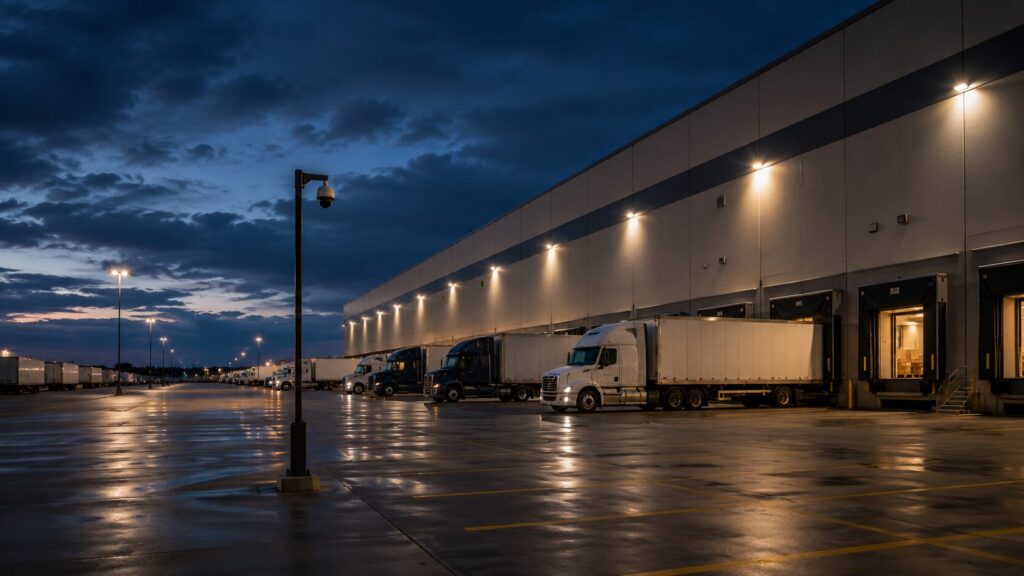
The perimeter is the first point of control. It helps determine who enters the property and when. The truck yard needs visibility into parked trailers, vehicle movement, and after-hours activity. Loading docks need especially strong controls because they are where freight changes custody.
Inside the building, the security plan needs to account for both people and inventory. Warehouse aisles need visibility so teams can see what is happening in active work areas. High-value storage areas may need tighter access rules. Returns and exception areas often need clear review procedures because they involve freight that is damaged, disputed, delayed, or harder to reconcile.
Critical systems also need protection. Server rooms, warehouse management systems, access control platforms, cameras, and fire/life safety systems all support daily operations. If those systems are disrupted, the facility may lose visibility into what is happening on-site. Fulfillment may slow. A small incident can become a larger business interruption.
A good security plan connects these areas instead of treating them as separate problems. The goal is not only to prevent theft. It is to improve visibility, reduce downtime, support investigations, and help employees work safely.
The Major Threats Distribution Centers Need to Plan For
Distribution centers face a mix of external, internal, and operational risks. Some involve theft. Others involve safety, system disruption, or poor visibility into what happened.
| Threat | What it may look like | Why it matters |
|---|---|---|
| Cargo theft and fraudulent pickup | Fake credentials, spoofed carrier information, or unauthorized shipment release | High-value freight may leave the facility without proper verification |
| After-hours intrusion | Activity around gates, yards, trailers, or dock doors when staffing is limited | Teams may not know whether an event is routine or a real threat |
| Insider shrink and operational loss | Mislabeling, over-picking, unauthorized removal, or inconsistent returns review | Loss can be difficult to investigate without connected systems |
| Unauthorized access | Expired badges, contractor drift, or visitors without clear sponsorship | People may enter areas they should not access |
| Cyber-physical risk | Disrupted cameras, access control, warehouse systems, or automation tools | A system issue can quickly become an operational issue |
| Fire and life safety risk | Fire, flooding, power loss, or equipment failure | Safety incidents can interrupt operations and put employees at risk |
Cargo Theft and Fraudulent Pickup
Cargo theft can happen on the road. It can also happen at or near the facility.
Distribution centers can be attractive targets because they concentrate inventory in one place. High-value loads may sit in trailers, staging lanes, or dock areas. Criminals may also use fraudulent pickup tactics, including spoofed carrier information or fake credentials.
A strong security program should verify more than the truck. It should verify the driver, appointment, trailer, and shipment release process.
After-Hours Yard and Dock Intrusion
Distribution centers often have large exterior footprints. A facility may have long fence lines, multiple gates, trailer parking, and dozens of dock doors.
After hours, those areas can become vulnerable. Weak lighting can limit visibility. Blind spots can leave activity unverified. Alarm events can be harder to interpret when no one is on-site to confirm what happened.
Insider Shrink and Operational Loss
Not every loss starts outside the building.
Inventory can be misdirected, over-picked, mislabeled, or removed from restricted areas. Returns and exception workflows can also create risk if they are not reviewed consistently.
These issues are often hard to investigate when video, access logs, alarms, and inventory records are disconnected.
Unauthorized Access and Contractor Drift
Distribution centers often rely on a changing mix of full-time employees, temporary labor, vendors, drivers, and contractors.
That creates access challenges. A badge that is not removed quickly can become a risk. A contractor who enters the wrong zone can create safety and security problems. A visitor without a clear sponsor can move through the site with limited accountability.
Access control should reflect real operations. It should account for roles, schedules, restricted areas, and temporary access needs.
Cyber-Physical Risk
Modern distribution centers depend on connected systems. Warehouse management systems, access control platforms, camera systems, conveyors, scanners, and other operational technology may all affect how the facility runs.
NIST SP 800-82 Rev. 3 provides guidance for securing operational technology while accounting for performance, reliability, and safety requirements. NIST also notes that OT includes systems and devices that interact with the physical environment.
That matters for distribution centers. A cybersecurity issue can become an operational issue very quickly. If access control, cameras, warehouse systems, or automation tools are disrupted, the facility may lose both visibility and throughput.
Fire, Safety, and Business Interruption
Security is broader than theft prevention.
Distribution centers need to protect employees during emergencies. They also need to reduce the risk of major operational disruption from fire, flooding, power loss, or equipment failure.
A Layered Approach to Distribution Center Security
The strongest distribution center security programs use layers. Each layer supports the next. If one control misses something, another can help detect, delay, verify, or document the event.
1. Start With a Facility Security Assessment
Before adding equipment, start with the way the facility actually works.
A useful assessment should follow the flow of people, freight, and vehicles. Look at how inbound loads arrive. Review how trailers are staged. Confirm how dock assignments are handled. Then evaluate how outbound shipments are released.
A practical assessment should answer three questions:
- Where is the facility most exposed? This may include gates, trailer yards, loading docks, high-value cages, returns areas, or employee entrances.
- Where is the team losing time? Slow investigations, frequent false alarms, and unclear incident reports can point to gaps in the current program.
- Where is the facility relying too heavily on people? Employees should not be expected to solve security problems without the right systems and escalation procedures.
The goal is not to add technology everywhere. The goal is to understand where better controls, visibility, or procedures would reduce risk.
2. Secure the Perimeter and Truck Yard
For a distribution center, the perimeter is more than the fence line. It includes gates, vehicle lanes, visitor entry points, employee parking, trailer lots, and dock approaches.
A stronger perimeter plan may include:
- Gate control
- License plate recognition
- Video coverage at vehicle entry points
- Lighting that supports camera visibility
- Intrusion detection along vulnerable areas
- Clear procedures for drivers, visitors, and vendors
The goal is not to slow every movement. The goal is to make sure movement is authorized, visible, and documented.
This is especially important in the truck yard. Trailers may sit for extended periods. Drivers may arrive outside normal office hours. Overflow lots may be physically separated from the main building. Without the right visibility, a facility may not know whether activity is expected until after a loss has occurred.
3. Treat Dock Doors as Critical Security Points
Dock doors are often one of the most important boundaries in a distribution center.
They connect the secure interior to the yard. They are also where freight changes custody. That makes them important for both security and operational control.
A dock security plan should account for:
| Dock security need | Why it matters |
|---|---|
| Door status | Helps teams know whether a dock door is open, closed, or active |
| Trailer assignment | Connects dock activity to the correct trailer or shipment |
| Driver verification | Reduces the risk of unauthorized pickup |
| Outbound release approval | Helps prevent freight from leaving before proper release |
| Video coverage | Creates a visual record of dock activity |
| Seal checks | Adds control for high-risk or high-value loads |
The strongest dock workflows connect access events, video, and shipment data. That gives managers a clearer record of what happened and when.
4. Use Video Surveillance as the Visual Foundation
Video surveillance is one of the most important parts of distribution center security. It can deter theft, document incidents, and support operational review.
Guardian Alarm’s business camera systems are designed to help businesses stop crime before it happens and improve visibility into operations.
The best camera plan is not based on maximum coverage alone. It is based on useful coverage.
A stronger camera plan prioritizes the areas where visibility matters most:
- Gates and vehicle entrances
- Dock doors and loading lanes
- High-value storage areas
- Employee entrances
- Returns and exception areas
- Yard zones where lighting supports clear footage
Camera placement should also respect privacy. Cameras should protect employees, visitors, and property without recording areas where privacy is expected.
5. Add Remote Video Monitoring for Live Intervention
Traditional cameras often help after an incident. Remote video monitoring can help while an incident is happening.
Guardian Alarm’s Virtual Guardian service uses real-time video surveillance and live voice communication so trained analysts can intervene when a threat appears.
This can be especially useful in parts of the facility that are difficult to watch continuously. A truck yard may have long periods of quiet activity followed by sudden movement. Loading docks may be active during some shifts and exposed during others. Remote buildings and overflow lots can also create visibility gaps when staff are focused elsewhere.
Remote monitoring gives the facility another layer of response. If a person enters a restricted area after hours, trained monitoring personnel can review the video, issue a live audio warning, and escalate the event when needed.
For distribution centers, this is especially valuable when the site has:
- A large exterior footprint
- Limited overnight staffing
- Repeated after-hours incidents
- Remote yards or overflow lots
- Areas that are difficult for on-site staff to watch continuously
Remote monitoring helps the security program move from passive recording to active response.
6. Control Access for Employees, Drivers, Contractors, and Visitors
Not everyone in a distribution center needs access to every area.
Drivers may need access to a check-in area, but not the warehouse floor. Contractors may need access to a specific work zone, but only for a limited period of time. Employees may need access based on their role, shift, or department.
Access control helps distribution centers manage those differences. It also creates a record of who entered restricted areas and when.
Guardian Alarm’s commercial access control systems include cloud-based management, customizable access levels, and integration with systems such as intrusion alarms, video cameras, HR databases, and visitor management tools.
A practical access control plan should define:
| Person or group | Access question to answer |
|---|---|
| Employees | What areas should this person access based on role, shift, or department? |
| Drivers | Where can the driver go after check-in? |
| Contractors | What work zone is approved, and when should access expire? |
| Visitors | Who sponsored the visit, and does the visitor need an escort? |
| Former employees | Has access been removed quickly after departure? |
This is a major improvement over shared keys or one-size-fits-all access. With individual credentials, each person can be assigned the right level of access. If someone changes roles, finishes a contract, or leaves the company, their access can be updated quickly.
Access events can also be tied to video. That gives managers a clearer view of what happened if there is a question about a restricted area, high-value storage room, employee entrance, or contractor work zone.
7. Protect High-Value Inventory and Exception Paths
Not every product carries the same risk. A risk-based plan puts stronger controls around inventory that is more likely to be targeted or harder to replace.
High-value inventory may need restricted storage, tighter access rules, better camera coverage, and more frequent review.
Exception paths also deserve attention. These include returns, damaged goods, relabeling, quality assurance, and outbound staging. Loss often hides in places where the normal process changes.
Think of inventory protection in three levels:
| Level | Security focus | Example |
|---|---|---|
| Level 1 | Visibility | Cameras cover key storage, returns, and staging areas |
| Level 2 | Access control | Only approved employees can enter high-risk zones |
| Level 3 | Evidence and review | Video, access logs, inventory records, and notes are connected |
This helps teams avoid treating every issue as isolated. If the same area, shift, process, or vendor appears repeatedly in incident reviews, the facility can respond with better controls.
8. Use Intrusion Alarms and Verified Response Workflows
Intrusion alarms remain essential for distribution centers. The system should reflect how the facility actually operates after hours.
A good alarm design separates the site into meaningful zones. Gate activity may need one response workflow. Dock doors may need another. Motion inside the warehouse may require a different level of review, especially if overnight crews or cleaning teams are sometimes present.
The key is verification. When an alarm is triggered, the first question should be whether the activity is expected.
| Alarm event | Response question |
|---|---|
| Gate activity | Is the vehicle expected or unauthorized? |
| Dock door opened | Was the door scheduled to be active? |
| Motion in warehouse | Is there an approved overnight crew? |
| High-value room access | Was the person authorized for that area? |
| Repeated false alarm | Does the device, schedule, or process need to be fixed? |
Video verification can make alarm response more efficient. It helps teams determine whether an event is a real threat, an employee error, or an equipment issue.
Guardian Alarm’s UL-certified monitoring center responds to intrusion, fire, and carbon monoxide emergencies and dispatches authorities when needed.
9. Do Not Overlook Fire, Life Safety, and Environmental Monitoring
Distribution centers can face serious fire and environmental risks. Large storage areas, electrical rooms, battery charging areas, and high-volume operations all require careful planning.
A strong life safety program should include monitored detection, inspection schedules, staff training, and clear evacuation procedures.
Environmental monitoring may also matter. Some facilities need alerts for water intrusion, power loss, temperature changes, or equipment issues. These events can damage inventory and disrupt operations even when no theft occurs.
Security should support continuity. A facility that cannot operate safely cannot serve customers.
Guardian Alarm provides commercial fire alarm monitoring and life safety solutions that pair safety alarms with 24/7 monitoring for businesses.
10. Secure OT, WMS, and Security Technology
Physical security and cybersecurity now overlap.
A camera system can create risk if it is poorly secured. So can an access control dashboard. Warehouse management systems and operational technology need even more attention because they can affect fulfillment.
Practical security steps include:
- Segment security networks from guest networks
- Limit access to warehouse and OT systems
- Use multi-factor authentication where possible
- Remove former employee access quickly
- Keep software and firmware updated
- Back up critical system configurations
- Review vendor remote access carefully
A distribution center should treat security technology like business-critical infrastructure. If cameras, access control, alarms, or warehouse systems fail, the facility may lose visibility at the worst possible time.
11. Build a Better Incident and Evidence Process
After an incident, the quality of the response matters. Poor evidence handling can slow investigations and weaken claims.
A complete incident file should make the event easy to understand later.
| Question | What to capture |
|---|---|
| What happened? | Incident summary and category |
| When did it happen? | Time stamps from video, access control, alarms, or WMS activity |
| Where did it happen? | Gate, dock, aisle, storage area, office, or yard zone |
| Who was involved? | Employee, driver, contractor, visitor, or unknown person |
| What evidence exists? | Video clips, photos, access logs, shipment records, and notes |
| Who reviewed it? | Manager, security lead, HR, insurer, or law enforcement contact |
| What happened next? | Resolution, escalation, or corrective action |
For cargo theft and organized activity, consistency is especially important. Small details can matter across multiple incidents, locations, carriers, or time periods.
Distribution Center Security Self-Audit
Use these questions to evaluate whether your current security program is covering the basics.
| Area | Ask this question |
|---|---|
| Perimeter | Are gates, fences, and vehicle entry points visible and monitored? |
| Truck yard | Can you verify after-hours activity around trailers? |
| Docks | Can managers match dock activity to video and shipment records? |
| Access control | Are credentials role-based, shift-aware, and easy to revoke? |
| Visitors | Do visitors and contractors have sponsors and expiration rules? |
| High-value inventory | Are restricted storage areas protected with access logs and video? |
| Returns and QA | Can exception activity be reviewed consistently? |
| Alarms | Are alarms verified before escalation when possible? |
| Fire and life safety | Are monitored systems, inspections, and evacuation procedures current? |
| Cybersecurity | Are security systems and warehouse systems protected from unnecessary access? |
| Evidence | Can incident files be created quickly and retrieved later? |
| Training | Do employees know when to report, disengage, or escalate? |
How Guardian Alarm Helps Distribution Centers Build Stronger Security
Distribution center security works best when systems are connected. Cameras, alarms, access control, monitoring, and fire protection should support the same operating plan.
For a distribution center, that might mean cameras at dock doors, access control for restricted areas, alarm monitoring after hours, and remote video monitoring across the truck yard. Fire and life safety systems should also be part of the same risk plan.
Guardian Alarm can help distribution centers assess vulnerabilities, design a layered program, and implement security solutions that protect people, freight, and operations.
