
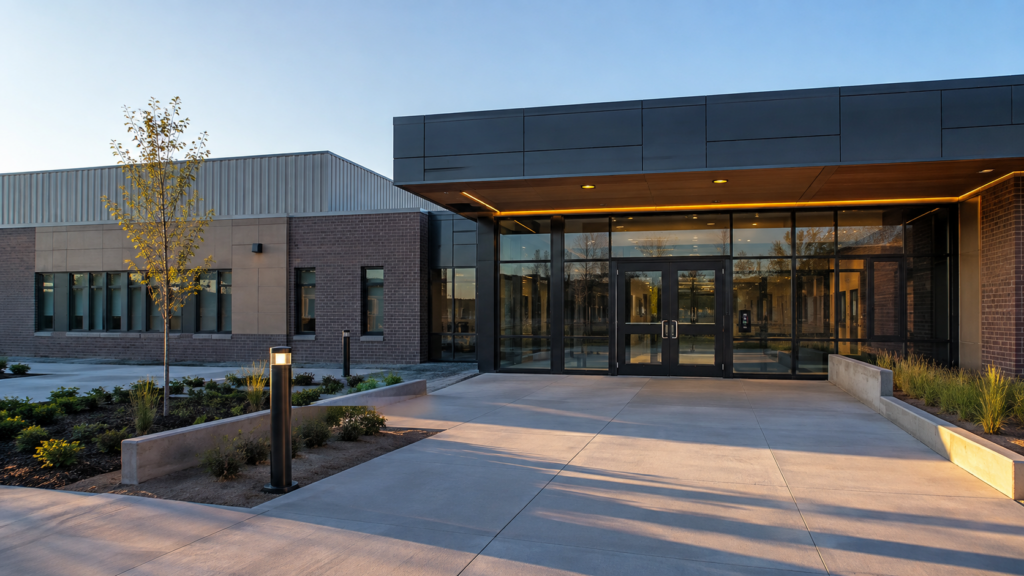
School Security Systems: A K-12 Building Playbook
School security is not a product. It is a sequence of decisions about how a building lets people in, how it knows who is inside, and how quickly staff can act when something changes.
Districts that treat it as a purchase end up with equipment that does not change outcomes. Districts that treat it as a design problem end up with buildings that behave correctly under pressure.
This playbook walks a K-12 building the way a security designer walks it, from the curb to the classroom door.
Start at the property line, not the front door
Most school security conversations begin at the entrance. They should begin at the curb. Parking areas, bus loops, athletic fields and portable classrooms are where after hours incidents concentrate, and they are consistently the least covered part of a campus.
What works at the property edge:
- Exterior cameras positioned along the approach paths rather than aimed at the building face, so people are walking toward the lens at face height
- Adequate and uniform lighting on every pedestrian route, including the path from the staff lot to the building
- Clear sightlines from the main office toward the primary approach
- Camera coverage of the bus loop and the athletic field access points
- Landscaping trimmed so it does not screen doors or windows from view
Districts frequently fund interior cameras before exterior lighting. Reversing that order produces better results for less money.
The entry vestibule is the highest leverage investment
A secured vestibule forces every visitor through a controlled interaction before they reach students. The concept is simple and the execution is where districts get it wrong.
A vestibule works when:
- The outer door is unlocked only during arrival and dismissal windows, and locked otherwise
- The inner door is always locked and released only from the office
- Office staff have a camera view and an intercom before they release anyone
- Visitor management, including identification and a printed badge, happens inside the vestibule rather than after it
- There is no alternate route from the vestibule into the building
A vestibule fails when staff prop the outer door during arrival for convenience, when the inner door release has no verification step, or when a second unmonitored entrance makes the vestibule optional. That third failure is the most common and the most expensive to discover, because it means the entire investment can be bypassed by anyone who knows the building.
Walk your building and find every door a person could enter without passing the vestibule. That list is your project.
Access control and the credential problem nobody plans for
Schools have enormous credential churn. Staff, substitutes, contractors, coaches, custodians, food service workers, after hours facility renters and volunteers. Every one of those groups needs access at some point, and most districts have no consistent process for taking it back.
Systems that hold up have three things:
Credential ownership. One named person is responsible for issuing and revoking. Not a committee, not whoever is in the office that day.
Scheduled access. Doors unlock and lock on a schedule, and the schedule accounts for early arrival staff, athletics, community use and summer operations. A custodial credential that opens a door at 2 a.m. on a Sunday in July is a gap nobody is thinking about.
A revocation trigger. Offboarding is tied to the same process that ends a payroll record or closes a facility rental. Manual revocation gets forgotten within a semester.
Mechanical keys make all three of these impossible to enforce. A single unreturned key is an uncontrolled opening until the cylinder is changed, and districts rarely change cylinders because the cost is visible while the risk is not.
Camera placement that answers real questions
Camera placement in schools should be driven by the questions administrators actually need answered:
Who entered and when. Every exterior door, angled along the approach to capture faces rather than the back of a head at the threshold. Mount at eight to ten feet, not fifteen. Higher mounting produces top of head views and defeats identification entirely.
Where did the movement go. Corridor intersections and stairwells rather than the middle of long hallways.
What happened in a shared space. Cafeteria, gym, media center, bus loop, main office.
What happened after hours. Exterior elevations, mechanical areas and the roof access points.
Classrooms are typically excluded, and that is a policy decision worth documenting in writing before the first camera goes up. So is who may view live feeds, which should be a short named list rather than a broad permission.
Set retention long enough to cover the delay between an incident and its report, which in schools can be weeks. Thirty days is a common baseline and often too short.
Communication and response
Technology only matters if it shortens the time between “something is wrong” and “someone is helping.”
- Alarm signals routed to a UL listed monitoring center rather than to a single staff cell phone
- Verified video attached to alarm events so responding agencies know what they are walking into
- A mass notification capability that reaches staff phones and building systems together
- A documented lockdown procedure that staff have practiced rather than read
- Integration so an alarm event pulls the relevant camera view automatically
Test the notification path on a schedule and document the results. An untested system is an assumption.
Fire alarm and life safety documentation
School fire alarm systems carry inspection and testing obligations under NFPA 72, and districts are routinely asked to produce documentation during an inspection, an insurance review or a bond process. Keep inspection records, test results, deficiency corrections with dates, impairment records and any panel upgrade documentation in one accessible file.
The system being functional and the system being documented as functional are two different compliance positions, and only one of them survives an audit.
A phased approach for a real budget
Districts rarely fund everything at once. A defensible sequence:
- Secure the primary entrance and build a working vestibule
- Bring every exterior door onto controlled access with position monitoring and held open alarms
- Exterior camera coverage on approaches, parking and the bus loop
- Interior corridor and shared space coverage
- Mass notification and lockdown capability
- Integration, so an alarm event pulls the relevant camera view automatically
Fund the infrastructure early. Cable pathways and controllers only become more expensive and more disruptive to install as buildings stay occupied.
After hours, athletics and community use
School buildings are occupied far beyond the instructional day, and the after hours picture is where most access control designs break down.
Evening athletics, community rentals, adult education, youth programs, board meetings and summer maintenance all put people in the building at hours the security posture was not designed for. The usual result is that someone unlocks a set of doors at 5 p.m. and the building stays open until whoever is last remembers to lock it.
A workable approach:
- Partition the building so a gym or a cafeteria can be accessible while the academic wing stays secured. This is the single most valuable design decision for schools with heavy community use.
- Schedule access to the event, not to a general evening window. A rental credential should work for the hours of the rental and no longer.
- Give facility renters credentials rather than keys, with expiration dates set at issuance.
- Alarm the unused portions of the building independently, so an evening event does not require disarming the whole facility.
- Set a no close alert, so a building left unsecured at midnight generates a call rather than a discovery the next morning.
Summer, breaks and construction
Extended breaks change the risk profile completely. The building is empty for weeks, contractors are on site for renovation work, and the normal staff who would notice something wrong are not there.
Before each extended break: revoke credentials for anyone who has left, issue scheduled contractor credentials with expiration dates, confirm the alarm arms cleanly with no bypassed zones, verify exterior lighting, and confirm the monitoring contact list reflects who is actually available. Copper and metal theft at unoccupied school buildings is a persistent regional problem, and summer is when it happens.
FAQ
How many cameras does a typical school need?
There is no per square foot rule. Count exterior doors, corridor intersections, shared spaces and exterior approaches, then place to those. Coverage of the right locations beats total count every time.
Should classroom doors be on electronic access control?
Usually not, for cost reasons. Classroom doors should lock from the inside without requiring a teacher to step into the corridor, which is a hardware specification rather than an electronic one.
How long should schools retain video?
Long enough to cover the reporting delay on incidents that surface late. Thirty days is a common baseline. Check your state records requirements and district policy.
Who should be able to view live camera feeds?
A short, named list documented in policy. Broad live access creates privacy exposure and rarely improves response.
What is the most common gap in school security?
A secondary entrance that bypasses the vestibule, followed by credentials that were never revoked.
