
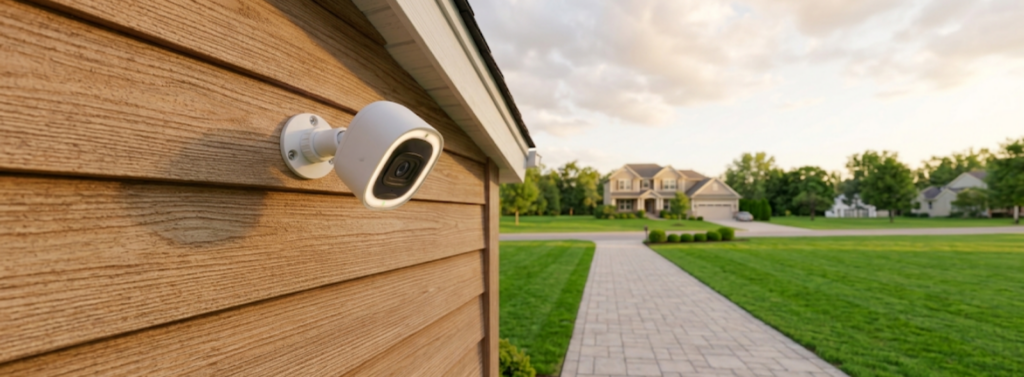
Do Security Cameras Deter Burglars?
What 422 Convicted Burglars Told Researchers
What the Evidence Supports, & What It Doesn’t
Yes – though the honest answer is “meaningfully, but not absolutely.” In the largest offender survey of its kind, more than 40% of convicted burglars said visible cameras would prompt them to choose a different target, and nearly 60% factored surveillance into target selection at all. Cameras raise perceived risk of capture, and perceived risk is what opportunistic offenders are actually pricing.
Quick Takeaways
- Cameras change target selection. In a survey of 422 convicted burglars, nearly 60% said they consider cameras and surveillance equipment when sizing up a target, and more than 40% said cameras would push them toward a different house.
- Alarms test even stronger. In the same study, about 83% tried to determine whether an alarm was present, and roughly 60% would move on if they found one; which is why cameras and monitored alarms work best together, not alone.
- Visible beats hidden for prevention. Hidden cameras document a break-in after it happens. Visible outdoor security cameras discourage the attempt in the first place.
- Placement decides everything. Cameras mounted eight to ten feet above primary entry points stay out of reach while remaining unmistakable to anyone approaching.
- Active deterrence closes the gap. Cameras that respond in real time — light, audio, live verification — interrupt an intrusion at the property line rather than recording it.
Most homeowners think about security in terms of what happens during a break-in — sirens, response times, verified alerts. Those layers matter. But the best outcome is the one where nobody tries. Visible outdoor security cameras are the clearest signal you can send that your home is monitored, and that signal does work on the people most likely to target a residence.
What the evidence does not support is the idea that a camera makes a home untouchable. Determined and repeat offenders are markedly less deterred than opportunists. Cameras are one layer in a system, and the research is clearest about them when they are paired with monitored alarms and visible signage.
The Psychology of Burglary:
How Offenders Weigh Risk and Reward
Most residential burglaries are crimes of opportunity, not planned operations. An offender walking a street runs a fast mental calculation: how hard is entry, how much cover is there, and who might see me?
Criminologists study this under situational crime prevention — the premise that changing the conditions around a target changes offender behavior, independent of the offender’s underlying motivation.
What 422 convicted burglars said
The most-cited data on this comes from Understanding Decisions to Burglarize from the Offender’s Perspective (Blevins, Kuhns & Lee, 2012), a 64-page study led by Dr. Joseph B. Kuhns of the University of North Carolina at Charlotte that surveyed 422 randomly selected incarcerated burglars across North Carolina, Kentucky, and Ohio. Its relevant findings:
- Pre-attempt screening: About 83% said they would try to determine whether an alarm was present before attempting entry.
- Alarm avoidance: Roughly 60% said they would seek an alternative target if they found signs of an alarm.
- Camera avoidance: Nearly 60% said they would consider cameras or other surveillance equipment during target selection, and more than 40% said that would prompt them to choose a different target.
- Mid-attempt retreat: About half said they would discontinue an attempt after discovering an alarm partway through.
Disclosure: this study was funded by the Alarm Industry Research and Educational Foundation, under the Electronic Security Association. We think the findings are useful and widely corroborated, and you should know who paid for them.
For an independent view, a 2019 systematic review in Criminology & Public Policy (Piza, Welsh, Farrington & Thomas) pooled 80 separate CCTV evaluations spanning four decades. It found surveillance associated with a modest but statistically significant decrease in crime, including a reduction of roughly 12% in residential settings. Two details matter for homeowners. Schemes with active monitoring produced larger effects than passive recording. And schemes that paired cameras with other security measures outperformed cameras deployed alone — the authors specifically caution against treating CCTV as a stand-alone crime prevention measure. That maps directly onto why active deterrence outperforms a camera that only records, and why a camera belongs in a system rather than on its own.
Visible vs. Hidden Security Cameras:
Which Should You Choose?
For preventing a break-in, visible cameras outperform hidden ones. A hidden camera captures evidence of an intrusion that already happened. A visible camera works on the decision that happens before it.
| Visible Outdoor Cameras | Hidden Cameras | |
|---|---|---|
| Primary function | Prevent the attempt | Document the event |
| Deters target selection | Yes | No |
| Evidence quality | Good; may be avoided or obscured | Excellent; offender unaware |
| Best Use | Perimeter and entry points | Discreet indoor monitoring, specific investigations |
| Risk of tampering | Higher; mitigate with height | Low |
| Outcome if it works | No entry, no damage | Entry, damage, recorded footage |
Hidden cameras have real uses — discreet indoor monitoring and forensic capture among them. They just do not do perimeter defense, because a deterrent nobody can see is not deterring anyone.
A visible camera signals three things to anyone approaching: the owner takes security seriously, the property is tied to an active system, and movement is being recorded right now.
What about dummy cameras?
Fake cameras are cheap and occasionally fool an inexperienced offender, but they degrade quickly — no IR illuminators, no wiring, static housings, visible battery bays — and experienced offenders read those tells. More importantly, a dummy camera produces no footage, no alert, and no response when it fails. It buys appearance without capability.
Where to Place Outdoor Security Cameras for Maximum Deterrence
Placement determines whether a camera deters or merely records. A camera tucked under a dark eave behind shrubs has surrendered its deterrent value.
1. Front entryway: the primary focal point
The front door is among the most common residential entry points, which makes it the highest-value camera position on the property. A video doorbell or an overhead camera above the porch creates presence from the moment someone steps onto the walkway.
2. Secondary ground-level access points
Back doors, side garage doors, and basement walkouts are frequent secondary targets precisely because they are hidden from street view. A wide-angle camera with integrated LED illumination removes the shadow zones that make these points attractive. Guardian’s home security systems pair perimeter cameras with door and window sensors at exactly these entry points.
3. Driveway and garage approach
Driveways hold vehicles and lead to garage access. A bullet or turret camera on the garage facade covers the approach and establishes a security boundary at the property edge — before anyone reaches the house.
4. Ideal mounting height and angle
Mount outdoor cameras eight to ten feet above ground. This height does two jobs at once: it keeps the camera out of easy reach, and it keeps the housing and status lights clearly visible at eye level to anyone approaching. Angle down slightly to capture faces rather than the tops of heads. A common placement error that costs you usable identification footage. If you are not sure which points on your property need coverage, our three-minute security quiz maps a starting layout.
Active Deterrence:
When Cameras Respond Instead of Record
Passive recording is the old model. Modern systems use video analytics to distinguish people from animals, vehicles, and packages, which cuts the false alerts that make homeowners stop trusting their notifications.
When an unrecognized person lingers in a defined perimeter zone, a Guardian Alarm active deterrence camera responds automatically:
- Perimeter illumination — a focused LED floods the area, removing the cover of darkness.
- Audible warning — a clear tone signals that the person has crossed a monitored threshold.
- Live verification and two-way audio — you get a priority alert with live video and can speak to the person from anywhere.
This is the mechanism that matters. A recording camera raises perceived risk somewhat. A camera that visibly reacts removes the ambiguity: the offender now knows they have been seen, their face is captured, and a response is already underway. That is what interrupts the decision loop mid-approach.
Protect Your Home with Guardian Alarm
A secure home does not have to look like a fortress. Visible, well-placed, professionally monitored cameras do the work quietly — deterring the opportunistic majority while capturing what matters if anything does happen.
Guardian Alarm combines active deterrence cameras, intelligent video analytics, and 24/7 professional monitoring. Our security specialists handle layout design and professional installation so every camera has the sightlines and the visibility to earn its place.
Schedule a free home security consultation →
FAQs
Do security cameras actually deter burglars?
Yes, meaningfully. In a survey of 422 convicted burglars, more than 40% said visible cameras would prompt them to select a different target, and nearly 60% considered surveillance during target selection. Deterrence is strongest when cameras are clearly visible and paired with a monitored alarm.
Where should I install outdoor security cameras?
Cover primary entry points first: front door, ground-floor back doors, and garage or driveway access. Mount cameras eight to ten feet high — visible to anyone approaching, out of reach of tampering, and angled down enough to capture faces.
Should security cameras be hidden or visible?
Visible, for prevention. Hidden cameras only document a break-in after it occurs; visible cameras discourage the attempt. Hidden cameras remain useful for discreet indoor monitoring, but they cannot perform perimeter deterrence.
What is active deterrence on a security camera?
Active deterrence means the camera responds rather than just recording. When analytics detect an unauthorized person in a defined zone, the camera triggers an LED spotlight and an audible warning, and sends a live-verified alert — signaling detection before the person reaches a door.
Do fake security cameras work?
Marginally and unreliably. Dummy cameras lack the visual details experienced offenders check for, and they provide no footage, alert, or response when the deterrent fails. A single real camera outperforms several fakes.
