
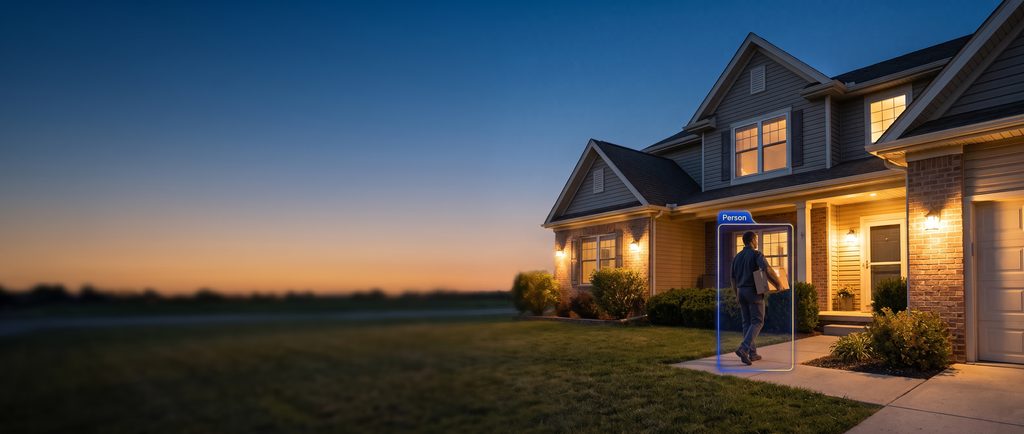
Analog vs IP security cameras
what changes when you upgrade
If your security cameras connect to a DVR, the recorder box that stores your footage, you have an analog camera system. It probably still works, and the picture may look fine. So when someone suggests switching to IP cameras, it’s fair to ask what you would actually gain.
This guide compares analog vs IP security cameras in plain language, starting with how each one works and ending with what changes in daily life when your cameras can analyze what they see. If you’re a Guardian Alarm customer with analog security cameras, it will help you decide whether moving to IP cameras makes sense for your home.
Quick Takeaways
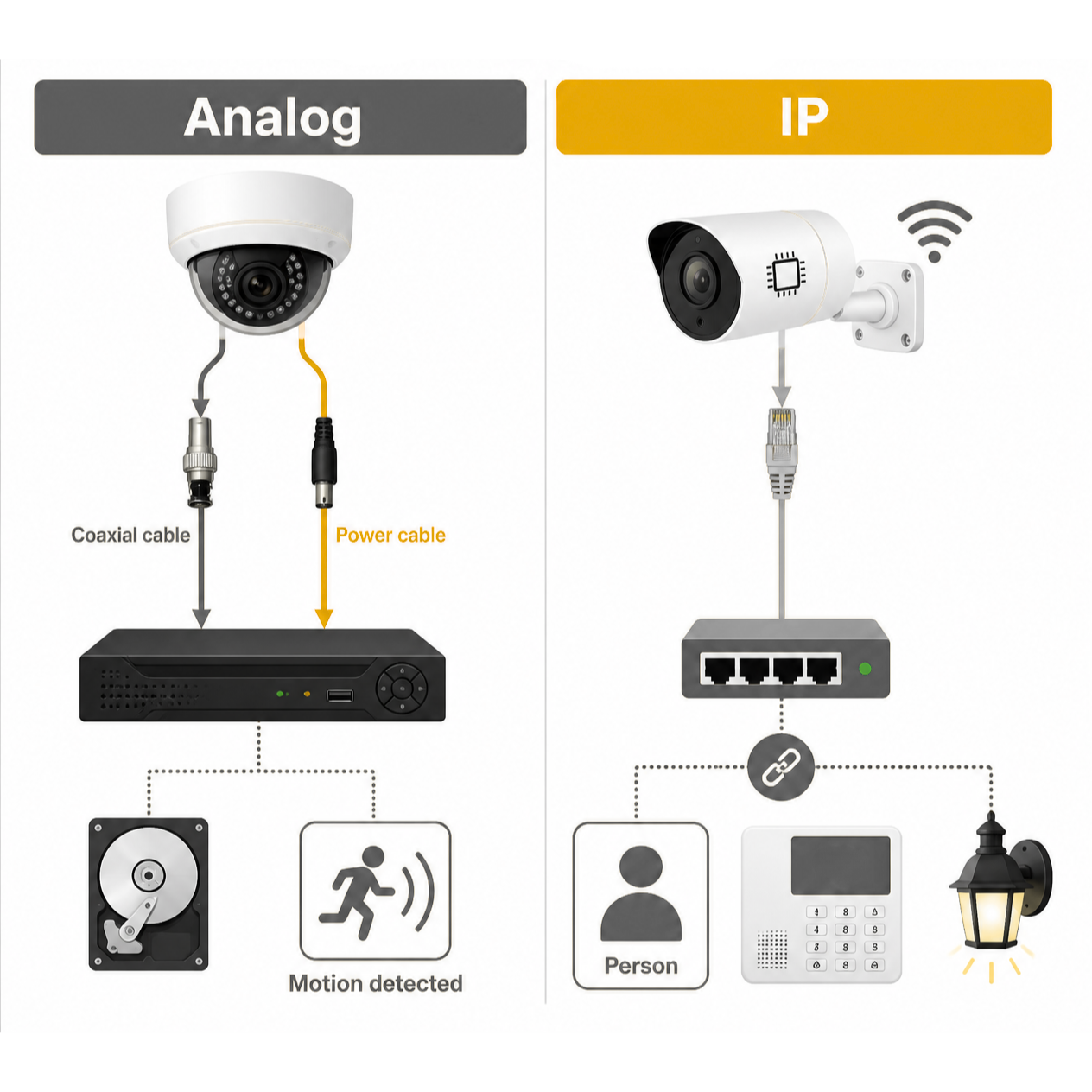
- Analog cameras send video over coaxial cable to a DVR, which records it to a hard drive. IP cameras turn video into digital data inside the camera and can analyze it before it’s stored.
- Picture quality is closer than most analog vs IP security camera comparisons suggest. A 1080p analog camera and a 2MP IP camera capture about the same number of pixels.
- The biggest difference between analog and IP security cameras is intelligence. IP cameras with video analytics can tell people, cars and pets apart, which means fewer unwanted alerts.
- Alarm.com IP cameras can work with your security panel, smart locks and automation rules, so something a camera sees can trigger an action at home.
- Wi-Fi and Power over Ethernet (PoE) cameras need less wiring than running coax and power to every analog camera.
How analog security cameras work
An analog camera captures video and sends it as an analog signal over coaxial cable to a digital video recorder, or DVR. The DVR converts that signal into digital files, records them to its hard drive and handles playback. Each camera typically needs its own coax run back to the recorder, plus a separate power line.
In this setup the camera is mostly a lens and a sensor. Any detection happens at the DVR, and in many analog systems that means basic motion detection, which looks for movement against a fixed background scene (Wikipedia, Video content analysis). A tree branch moving in the wind counts as motion just as much as a person walking up your driveway.
Analog has improved, too. Several of the analog DVRs on Guardian customer accounts record at 1080p, a high-definition format. If your system is one of them, it records at 1920 by 1080 pixels, about 2.1 megapixels per frame (Wikipedia, 1080p).
How IP security cameras work
IP stands for Internet Protocol, the same networking standard your computer and phone use. An IP camera converts video into digital data inside the camera itself and sends it over your home network, either by Wi-Fi or through an Ethernet cable. Because the processing happens in the camera, an IP camera works more like a small computer than a lens on a wire. It can analyze its surroundings, connect to home automation and send real-time alerts. Where the processing happens is the root of every other analog vs IP security camera difference in this guide.
Many wired IP cameras use Power over Ethernet. PoE is a standard the Institute of Electrical and Electronics Engineers adopted in 2003, and it carries power and data over a single network cable (IONOS). Wi-Fi cameras skip the video cable entirely and connect to your wireless network.
DVR vs NVR: what’s the difference?
You may see the terms DVR and NVR side by side when you read about analog and IP security cameras. A DVR is built for analog cameras: it receives analog signals and turns them into recordings. A network video recorder, or NVR, does the equivalent job for IP cameras, receiving video that is already digital. Not every IP camera system is built around an NVR, so ask your installer how recording works with the cameras they recommend.
Analog vs IP security camera picture quality is closer than you think
Most analog vs IP security camera comparisons lead with resolution, as if every analog camera still records grainy footage. For a lot of homes, that picture is out of date.
Here’s the math. A 1080p frame is 1920 by 1080 pixels, about 2.1 megapixels (Wikipedia, 1080p). A 2MP IP camera captures roughly the same amount. Swap a 1080p analog camera for a 2MP IP camera and your footage won’t get dramatically sharper. What changes is what the camera does with each frame, which the next section covers.
Resolution does climb with higher-megapixel models. A 4MP camera captures about twice the pixels of a 2MP camera, so you get sharper images and clearer digital zoom when you enlarge a recording, without the heavy pixelation of a blown-up lower-resolution feed.
That’s why this guide treats resolution as a tiebreaker. The upgrade worth paying attention to is what happens after the camera sees something.
Smarter alerts: the biggest analog vs IP security camera difference
Basic motion detection reacts to change. Anything that alters the picture, like a branch moving in the wind, can register as motion. If you’ve ever stopped checking motion alerts because most of them turned out to be nothing, you already know the problem.
Video analytics take a different approach. Instead of reacting to any change in the image, the camera looks for specific objects. In video analytics this is called object detection: checking whether a type of object, such as a person or a car, is in the scene (Wikipedia, Video content analysis). Alarm.com IP cameras use analytics that tell people, cars and pets apart, so a tree branch blowing in the wind doesn’t set off an alert. You get fewer unwanted alerts, and the ones you do get are worth reading.
Picture a delivery arriving after dark in late November. A basic motion system can’t tell the driver from the shrub that’s been moving all afternoon. A smart security camera with person detection can, and it alerts you because a person is at the door.
Cameras that work with your security system
Camera comparisons usually treat cameras as standalone gear. In your home, they sit alongside your security system, and that connection is where IP security cameras pull furthest ahead of analog.
Alarm.com IP cameras can tie into your security panel, its armed and disarmed states, smart locks and automation rules. That turns the camera into a working part of your system. For example, a camera can record a clip the moment a front-door sensor trips, or your outdoor lights can turn on the moment camera analytics detect activity.
An analog camera records to the DVR, and what happens next depends on someone reviewing the footage. An IP camera connected to your security system can act in the moment.
That difference shows up most this time of year. Clocks fall back on Sunday, November 1, 2026 (Time Out), so more of each evening happens after dark. Outdoor lights that switch on when a door sensor or camera trips are a simple, practical improvement for the season.
Smart lock and automation features depend on the devices in your home. If you’re not sure what your current system supports, Guardian Alarm can tell you before you decide anything.
Wiring and installation for analog vs IP security cameras
Analog systems are wiring-heavy. Every camera typically needs coax for video and a separate power line, both run back to the recorder.
IP cameras give you more options. Wi-Fi models connect without a video cable, and PoE security cameras carry power and data on one network cable. Guardian’s IP camera options include Wi-Fi cameras for indoor and outdoor spots and a PoE mini bullet camera that works indoors or out.
A Wi-Fi camera depends on a good signal where it’s mounted, which is one reason placement matters. Guardian installs every upgrade professionally, so you won’t be running cable or mounting cameras yourself.
Should you upgrade your analog cameras to IP?
Here’s an honest way to decide between keeping your analog security cameras and moving to IP. An upgrade makes the most sense if:
- You’ve tuned out motion alerts because most of them are nothing.
- You want your cameras to work with your security system, smart locks or outdoor lights.
- You want sharper detail and zoom on key outdoor views, which is where 4MP cameras help.
- You’re planning to add cameras and would like fewer cable runs.
Your analog system may still suit you if it records clearly, you rarely use alerts and you’re comfortable reviewing footage after the fact. There’s no need to replace equipment that’s doing the job you need.
Choosing between analog and IP security cameras
Analog cameras still have a place. Many record clear HD video to a DVR, and if your system does what you need, it’s fine to keep it running. Picture quality matters less in the analog vs IP security cameras decision than it used to, because a 1080p analog camera and a 2MP IP camera capture about the same detail.
What separates analog and IP security cameras is what the camera does with the picture. IP cameras with video analytics can tell a person from a car, a pet or a branch in the wind, so the alerts you get are worth reading. Alarm.com IP cameras can also work with your security panel, smart locks and automation rules, which lets a camera record a clip or switch on outdoor lights the moment a door opens. Wi-Fi and PoE models cut down the wiring, and 4MP models add sharper detail when you need to zoom in.
With earlier sunsets and the holidays ahead, this is a practical time to look at what your cameras could be doing. If you’re a Guardian Alarm customer with an analog camera system, you can save 10% on the equipment price of your new IP cameras through November 30, 2026, with professional installation and no promo code needed. The upgrade includes a contract renewal, and our team can explain the details before you decide.
Call Guardian Alarm to find out which IP cameras fit your home and how they’ll work with the security system you already have.
FAQs
What is the difference between analog and IP security cameras?
Analog cameras send video over coaxial cable to a DVR, which records it to a hard drive. IP cameras convert video to digital data inside the camera and send it over a home network by Wi-Fi or Ethernet. That lets IP cameras analyze what they see, send real-time alerts and work with home automation.
Are analog security cameras obsolete?
No. Many analog systems still record clear video, and some record in 1080p high definition. What analog cameras lack is built-in intelligence. They record what happens, while IP cameras with video analytics can tell people, cars and pets apart, send real-time alerts and trigger actions through a connected security system.
What is the difference between a DVR and an NVR?
A DVR, or digital video recorder, records video from analog cameras and converts their signals into digital files. An NVR, or network video recorder, records video from IP cameras, which arrives already digital over the network. Some IP camera systems record in other ways, so ask your installer how recording works with your cameras.
Do IP security cameras have better picture quality than analog cameras?
It depends on resolution. A 1080p frame holds about 2.1 megapixels, so a 2MP IP camera and a 1080p analog camera capture similar detail. A 4MP IP camera captures roughly twice as many pixels as a 2MP camera, which means sharper images and clearer digital zoom when you enlarge footage.
Do I need new wiring to switch from analog to IP security cameras?
It depends on the camera type, and you’ll often need less wiring than before. Analog cameras typically need coaxial video cable plus a separate power line. Wi-Fi IP cameras connect to your home network without a video cable, and Power over Ethernet models carry power and data on one network cable.
